Running a business is hard, but the hassle of getting cheap, qualified leads is just annoying. It is fine if you have word-of-mouth referrals, but for consistent growth, relying only on referrals is an extra burden.
Luckily, there are paid ads, a savior for restoration companies. A paid ad strategy is a large marketing engine with extra capacity that you can use to grow your business. Ads are handy, fast, and can bring all the emergency calls which you require while being on the job.
There are different types of ads that have various features to make your lead generation hassle-free, secure, and comfortable even while you are managing crews. Ads not only make your client acquisition easy, but they also secure your revenue. If you plan to run water damage ads, you should take these considerations.

💡 The Marketing Trifecta
While Paid Ads generate instant high-intent leads, they should always be paired with strong organic foundations. Don't forget to implement our Complete Water Damage Restoration SEO Guide for long-term free traffic, and utilize our Restoration Social Media Strategy to build undeniable local community trust!
📊 The Current Paid Ads Landscape for Water Damage Restoration Businesses
If you want to know what the current ads space looks like, you should look at the whole picture. An omnichannel ads landscape means you are not just using one platform. You use Google Ads to catch people who have an emergency right now. Then, you use social media platforms like Meta, TikTok, and LinkedIn to build awareness before an emergency happens.
When a pipe bursts at midnight, homeowners do not scroll social media. They go to Google and search for emergency water extraction. This is high-intent search. But capturing intent on Google is very expensive. Cost-per-click (CPC) can be huge. To balance this out, you need to show up on social media. Meta and TikTok ads build trust with homeowners in your area. They see your brand, learn about your services, and remember you.
Attribution is also changing. It is hard to know which ad brought the customer. A person might see your video on Facebook on Monday, but call you from a Google search on Friday. Using omnichannel tracking helps you see this full path. Making use of different platforms, you can organize your budget according to the category. You do not need to store all your money into one ad network.
How To Create a Marketing Plan for a Water Damage Restoration Business?
If you are asking how to build a plan, the answer is simple. You need a blueprint that connects all your platforms. First, figure out the length of your sales cycle. In water damage, the cycle is usually very short. It is an emergency. Your marketing plan needs to put your phone number right in front of the customer the second they need it.
Start by setting up your Google Local Services Ads (LSAs) and exact match high-intent Search campaigns. Then, build Meta Lead Gen ads featuring before and after transformations. This covers both the emergency searches and the local awareness. When these two parts work together, you get a solid marketing plan. Let’s look at the exact steps you need to follow.
The 10 Step Omnichannel Ads Blueprint for Water Damage Restoration
I. Omnichannel Synergy
Balancing Google Intent + Social Awareness
Many restoration owners spend all their budget on Google Ads. The problem is that Google clicks are getting more expensive every year. If you only rely on search, your cost-per-acquisition (CPA) will keep going up. You are fighting against every other local competitor for the exact same click. This wastes ad spend and leaves you with a smaller profit margin.
The solution is to balance your Google intent with social awareness. You should run Meta and TikTok ads to local homeowners before they need you. Show them helpful tips about preventing water damage. When they have an emergency later, they will search your brand name on Google instead of a generic keyword. Brand clicks are much cheaper.
This synergy lowers your overall CPA. When people already know your brand from social media, they are more likely to click your Google ad and actually call you. It scales your Return on Ad Spend (ROAS) because you are building a trusted local name, not just fighting in a bidding war.
II. Search Campaign Architecture
Google/Bing Structuring
A common mistake is throwing all keywords into one big ad group. If you put "basement flood," "mold removal," and "water damage repair" together, your ads will not match what the user is searching for. When the ad does not match the search, people do not click. Even worse, you might pay for irrelevant searches like "car water damage repair."
You need to build a strict search campaign architecture. Group your exact match keywords into very tight ad groups. Have one group only for "emergency water removal" and another only for "flooded basement cleanup." Then, write ad copy that perfectly matches that exact problem. Also, make sure to add a massive list of negative keywords, like "auto," "phone," or "DIY," so your ads do not show up for the wrong things.
A tight structure aligns perfectly with algorithmic bidding. Google will see that your ads are highly relevant, which increases your Quality Score. A high Quality Score means you pay less for every click. This fix directly lowers your CPA and ensures your budget is only spent on high-intent emergency jobs.
How Much Should I Budget for Water Damage Advertising?
The problem many owners face is not knowing how much to spend. If you spend too little, Google will not show your ads enough to get data. If you spend too much without a plan, you will waste thousands of dollars in a few days. Water damage keywords can cost $20, $50, or even $100 per click in competitive areas.
The fix is to start with a realistic daily budget based on your local cost-per-click. Many companies start with $50 to $150 per day and adjust based on performance. This gives the platforms enough money to test different searches and find the people who actually want to call. As you get more leads, you can increase the budget.
Setting the right budget is important because it feeds the bidding algorithms. When the system has enough data, it optimizes your ads to find cheaper conversions. Knowing your budget helps you stay profitable and prevents you from pausing your ads too early before they have time to work.
III. Paid Social Audience Targeting
Meta/LinkedIn/TikTok
Most restoration ads on Facebook and TikTok fail because they target everyone in a 50-mile radius. Showing an ad for water extraction to a teenager living in an apartment is a waste of money. Broad targeting on paid social leads to high impressions but zero actual phone calls or leads. You just end up annoying people who do not own homes.
To fix this, use precise audience targeting. On Meta, target homeowners in specific zip codes with older houses. You can also use LinkedIn to target property managers, real estate investors, and plumbing business owners to build B2B referral partnerships. On TikTok, use local geographic tags to show up on the "For You" pages of people in your exact city.
Proper targeting means your ads only show to people who can actually hire you. It stops you from burning cash on empty clicks. When you target property managers on LinkedIn, one good lead can turn into a partnership that brings you jobs all year round. This drastically increases your overall ROAS.
IV. Automated Bidding Strategies
PMax/Advantage+/tROAS
Manual bidding takes too much time and is often inaccurate. If you sit at your computer trying to change bids by a few cents every hour, you will lose to competitors using smart systems. You simply cannot process the millions of data points that Google and Meta use to decide if a user is going to convert.
You need to switch to automated bidding strategies. On Google, use Target CPA (tCPA) or Target ROAS (tROAS) bidding. You tell Google exactly how much you are willing to pay for a phone call, and the system adjusts your bids automatically. On Meta, use Advantage+ campaigns to let the algorithm test different audience segments and find the cheapest leads for you.
Automated bidding saves you hours of work and scales your campaigns efficiently. The algorithms know when a user is most likely to call based on their browsing history. Allowing the machines to handle the bidding lowers your CPA over time because the system gets smarter with every conversion.
V. Ad Copy & Creative Testing
Search vs. Video/UGC
Many advertisers run the exact same ad copy for months. Over time, people get "ad fatigue." They stop noticing your image or your text. On Google Search, if your headline just says "Water Damage Company," it blends in with the rest. On Meta and TikTok, a boring stock photo of a wet floor will make people scroll right past you.
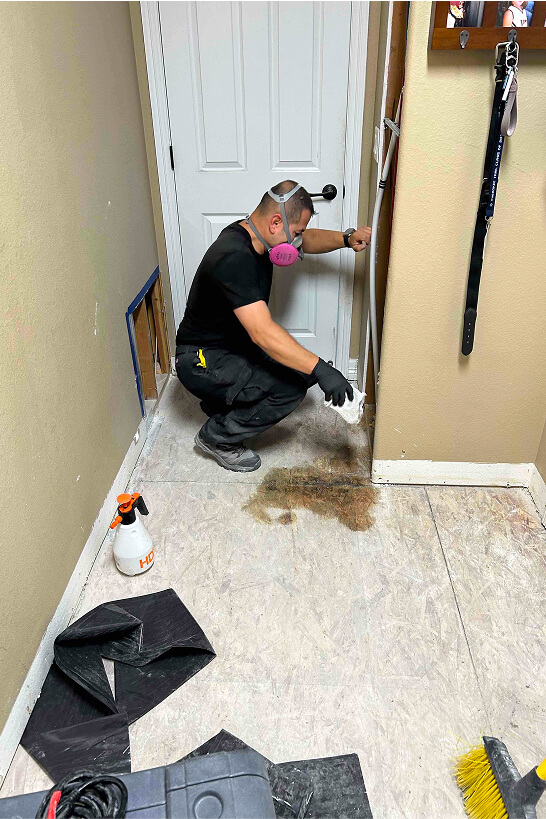
The solution is continuous ad copy and creative testing. For Search, test urgent headlines like "24/7 Response in 30 Mins" against authority headlines like "Voted #1 Restoration in [City]." For social media, test User-Generated Content (UGC). Record a quick video on your phone showing your crew extracting water from a real flooded basement. Show the before and after process clearly.
Testing tells you exactly what makes people click. A strong UGC video on TikTok or Meta builds massive trust because it looks real and not like a corporate commercial. When people trust your video, they click through to your site. This raises your Click-Through Rate (CTR) and drives down the cost of your ads.
What Is the Average ROI for Water Damage Ads?
A big problem is that business owners expect immediate, massive returns on day one. When they do not get a 10x return right away, they think the ads are broken. They do not realize that the first few weeks are a learning phase for the algorithms. They panic and shut off the campaigns, missing out on future profits.
The solution is to understand the benchmarks. In the water damage industry, a healthy average ROI (Return on Investment) for paid ads is typically around 300%. This means for every $1 you spend, you should make $3 back in revenue. You achieve this by tracking every single job that comes from your ads and calculating the total ticket value.
Knowing the average ROI keeps you grounded. It helps you make smart decisions about when to scale your budget. If you know your ROI is 300%, you will feel confident putting more money into the machine. It removes the emotion from media buying and lets you run your business based on math.
VI. Google Local Services Ads (LSAs) for Home Services
A major issue on regular Google Search is that you pay for the click, even if the person does not call. If someone clicks your ad by accident and leaves, you still lose $30 or more. This can drain your budget very quickly, especially in the home services space where clicks are extremely expensive.
To fix this, you must run Google Local Services Ads (LSAs). These pay-per-lead ads appear above traditional search ads. The best part is that you only charge for qualified leads. If someone clicks but does not call or message you, you do not pay. You need to pass a background check to get the "Google Guaranteed" badge, which builds instant trust.
LSAs are essential because they protect your budget. Paying only for actual phone calls guarantees that your money is going toward real opportunities. The Google Guaranteed badge also makes homeowners feel safe choosing you during a stressful emergency, which heavily increases your conversion rate.
VII. Meta Lead Gen Ads Featuring Before/After Transformations
Sending Facebook traffic to a slow, confusing website usually results in lost leads. A homeowner scrolling on their phone does not want to wait for your site to load, find your contact page, and fill out a long form. The friction is too high, so they just close the page and you lose the lead.
The exact fix is using Meta Lead Generation Ads. These ads keep the user on Facebook or Instagram. When they click "Get Quote," a simple form pops up that is already pre-filled with their name and phone number. To make these ads work, use a carousel of before-and-after photos showing a ruined room transformed back to normal.
Lead Gen ads remove all the friction from the process. It takes the user two seconds to request a call from you. Combining this easy form with powerful before-and-after visuals proves your expertise instantly. This strategy slashes your CPA because the conversion rate on native forms is much higher than on external websites.
VIII. Landing Page CRO (Conversion Rate Optimization)
A common error is sending Google Ads traffic straight to your homepage. Your homepage has too many links, about us sections, and distractions. If a user clicks an ad for "burst pipe repair" and lands on a page talking about carpet cleaning and mold, they will get confused and leave. This wastes the expensive click you just bought.
You must design a dedicated landing page for your paid ads. This is called Conversion Rate Optimization (CRO). A strong landing page should include a clear headline describing the service, emergency contact information, trust signals such as certifications, and a simple contact form. Make sure the page loads in under three seconds on mobile phones.
A highly optimized landing page acts like a digital salesperson that works 24/7. It converts more of your clicks into actual phone calls. When your conversion rate goes up, your cost per lead goes down. It also improves your Google Ads Quality Score, which makes your clicks cheaper.
IX. Cross-Platform Retargeting Sequencing
The sad truth is that a large percentage of people who visit your website will leave without calling you. Maybe they got distracted, or maybe they are waiting for their insurance company to reply. If you do not follow up with these visitors, you are leaving thousands of dollars on the table. They will likely hire a competitor later.
The fix is implementing cross-platform retargeting sequences. You must implement retargeting strategies to reach users who visited your site, emphasizing urgency and limited-time offers for conversions. Over the next seven days, you show them ads on Facebook, Instagram, and the Google Display Network.
Retargeting brings lost customers back to your business. It is the cheapest form of advertising because you are only showing ads to people who already showed interest. By staying in front of them for a week, you ensure that when they are finally ready to hire someone, they choose your company.
X. Server-Side Tracking/Attribution
Relying on old browser pixels is becoming a massive problem. With modern privacy updates and ad blockers, normal tracking pixels miss a huge chunk of your conversions. If you cannot track which ads are bringing in the phone calls, you are flying blind. You might turn off a winning ad because the data is broken.
The solution is to set up Server-Side Tracking and the Conversions API (CAPI). Instead of relying on the user's browser to send data back to Google or Meta, your actual website server sends the data directly to the ad platforms. You should also use call tracking software to record exactly which keyword generated every phone call.
Server-side tracking gives you accurate data. When the algorithms receive accurate conversion data, they perform much better. You will know exactly which campaigns are generating revenue and which ones are wasting money. This level of tracking is required if you want to scale your ROAS safely.
The Essential 5-Tool Paid Media Stack 🛠️
If you want to run these campaigns properly, you need the right gear. Just like a backpack has different compartments, your media buying needs different software tools. Here are the 5 tools you must have:
I. Servgrow
Type: Customer Relationship Management (CRM)
Servgrow is a customer relationship management software built specifically for water restoration pros. It provides scheduling, dispatching, job forms, and automated follow-ups via text and email.
- • Drastically reduces no-shows.
- • Allows you to track marketing sources easily.
- • It can take some time for new technicians to learn the mobile app in the field.
II. Xcelerate
Type: Job Management Software
Xcelerate is a complete job management software that connects field work with your office and marketing. It offers real-time job visibility, pipeline automation, and integrates with platforms like HubSpot.
- • Standardizes operations across multiple locations.
- • Gives great pipeline visibility.
- • Might be too robust and expensive for a brand-new, one-man operation.
III. CallRail
Type: Call Tracking
CallRail is an essential call tracking and analytics software. Since most of your water damage leads will come via phone calls, you must track them. It provides dynamic number insertion tied to clicks.
- • Tells you exactly which Google keyword or Meta ad resulted in a phone call.
- • The cost can increase if you have a massive volume of calls and need many phone numbers.
IV. ClickCease
Type: Click Fraud Protection
ClickCease is a click fraud protection tool. Water damage keywords are very expensive, and competitors sometimes click your ads to drain your budget. It blocks malicious IPs automatically.
- • Saves you thousands of dollars in wasted ad spend from bots and competitors.
- • Sometimes it can accidentally block a legitimate user if they click your ad multiple times while researching.
V. Triple Whale
Type: Advanced Tracking Dashboard
Triple Whale is an advanced tracking and attribution dashboard. It helps you see the full omnichannel journey using server-side tracking to bypass standard restrictions.
- • Centralizes all your media buying data so you never have to guess which platform is working.
- • It is a premium tool and can be pricey for smaller businesses with lower ad budgets.
Case Study 1: How Falcon Digital Marketing Scaled ROAS on Google Ads
Falcon Digital Marketing has over 12 years of experience managing water damage Google Ads accounts. They worked with a water damage restoration company that was struggling with high lead costs. The initial challenge was that the client was paying too much for generic clicks, and their CPA was eating all their profits.
Action The Execution:
To fix this, the agency implemented a highly targeted Google Search campaign. They separated the keywords into tight groups, prioritizing terms like "water cleanup" and "emergency flood damage repair". They also added strict negative keywords like "car restoration" and "DIY" to prevent wasted spend. They made sure the client owned their ad accounts for complete transparency.
📈 The Results:
The result was a massive reduction in wasted ad spend. By focusing on intent-based exact match keywords and adjusting bids based on performance, they slashed the CPA. The client was able to comfortably scale their monthly ad budget, turning a $3,000 spend into a highly profitable, predictable revenue stream.
Case Study 2: How Service Allies Slashed Acquisition Costs with Paid Social
A local water damage restoration owner found that his leads from search engines were drying up and becoming too expensive to maintain. He needed a new way to reach customers. Service Allies stepped in to help him utilize Facebook Ads, recognizing that social media could capture attention before users even made a search.
Action The Execution:
They created an ad campaign centered around a realistic scenario. They targeted local homeowners and wrote ad copy that highlighted the exact pain point: a flooded basement from a broken pipe. The ad used a simple "Learn More" button that opened a lead form. This allowed homeowners to input their contact information in just a few seconds without leaving the app.
📈 The Results:
The strategy was a huge success. The artificial intelligence on Facebook found the right users based on their online behavior and homeowner status. The restoration company slashed its acquisition costs because Facebook leads were much cheaper than Google search clicks. They were able to book high-value jobs directly from people relaxing on their couches.
Future-Proofing Your Ad Campaigns
If you want your restoration business to survive the next few years, you must prepare for changes. Privacy laws are making it harder to track users. Browsers are removing cookies, and people are using ad blockers. If you rely on basic tracking, your campaigns will break.
Implement Clean First-Party Data:
To future-proof your business, you must focus on first-party data. This means collecting names, emails, and phone numbers directly from your customers using your own forms. Once you have this list, you can upload it back to Google and Meta to create Lookalike Audiences. This helps the AI find more people who look exactly like your best past customers.
Embrace Machine Learning:
Also, lean heavily into AI automation. Let the platforms handle the bidding and the ad placements. Your job is to provide excellent creative assets. Keep taking high-quality photos and videos of your restoration jobs. Great creatives and strong server-side tracking will keep your ads profitable no matter what the industry does next.