Running a house cleaning service is hard work, but finding new clients should not be the hardest part of your job. Many cleaning businesses struggle with empty schedules and high advertising costs. If you are relying only on word-of-mouth or old flyers, you are missing out on a massive number of local customers looking for your exact service. Getting consistent bookings is a major pain point for most home service owners.
Luckily, paid advertising is a reliable solution for business growth. A balanced omnichannel paid ads strategy is the best way to secure a steady stream of new cleaning jobs. This means you do not just use one platform. Instead, you put your business in front of people on Google when they are searching, and on Facebook or TikTok when they are browsing.
If you plan to scale your cleaning company, you should take these considerations seriously. Paid ads not only make finding clients easy, but they also secure your revenue. Almost all successful cleaning companies use a mix of search and social media ads to lock in their local market.

💡 The Marketing Trifecta
While Paid Ads generate instant high-intent leads, they should always be paired with strong organic foundations. Don't forget to implement our Complete House Cleaning SEO Guide for long-term free traffic, and utilize our Cleaning Social Media Strategy to build undeniable local community trust!
📊 The Current Paid Ads Marketing Landscape for House Cleaning
The modern media buying environment is all about balance. You cannot just rely on a single source for leads anymore. The landscape involves capturing high intent on Google and building deep awareness on social media platforms.
If you want to grow, you need to understand intent. When someone types "house cleaning service near me" into Google, they have high intent. They want a cleaner right now. Google Ads captures this direct demand. However, these clicks are expensive because every other local cleaning company wants that same customer.
Social media builds awareness. People on Meta or TikTok are not actively searching for a mop and bucket. But, if they see an amazing video of a messy kitchen turning spotless, they might realize they need your help. Social ads build demand before the customer even goes to Google.
Furthermore, attribution is changing. Tracking how a customer found you is getting harder because of privacy updates. A customer might see your Facebook ad on Monday, but they might not search for your brand on Google until Thursday. An omnichannel strategy makes sure your business shows up at every step of their journey, ensuring you do not lose the lead to a competitor.
How Do I Advertise My House Cleaning Business?
Advertising your house cleaning business requires a mix of local visibility and visual proof. The first step is dominating local search results. When a local homeowner needs a deep clean, they usually want someone nearby. This means you must show up at the very top of the search engine results page.
Also, you must show people what you can do. Cleaning is a highly visual service. Before-and-after photos are powerful tools to show your quality of work. If you combine local search dominance with strong visual social media ads, you will create a lead generation machine.
To achieve this, you need a strict framework. The core strategy for Home Services is simple: use Google Local Services Ads (LSAs) for immediate trust, exact match Search campaigns for specific jobs, and Meta Lead Generation ads featuring before-and-after transformations. Let us break down exactly how to do this.
The 10-Step Omnichannel Ads Blueprint for House Cleaning
If you are ready to get more cleaning clients, follow these ten exact steps to build your paid media machine.
I. Omnichannel Synergy
Relying on just one advertising platform is a big risk. If your Google Ads account gets suspended, your phone stops ringing instantly. Many cleaning businesses face wasted ad spend because they treat Facebook and Google as completely separate efforts. They do not share data between the platforms, which leads to missed conversion opportunities and higher costs.
The solution is to balance Google intent with social awareness. You run Google Ads to capture people actively searching for "house cleaners in [City]." At the same time, you run Meta ads showing high-quality cleaning videos to people in that exact same city. You use the data from your website to see which platform is driving the best leads.
This omnichannel synergy lowers your blended Cost-Per-Acquisition (CPA). When people see your brand on Facebook first, they are much more likely to click your Google Ad later. This trust makes your ads cheaper and helps the algorithms find better customers for your business.
II. Search Campaign Architecture
Wasted ad spend on Google is a massive problem for cleaning companies. If you use broad match keywords, Google might show your ad for searches like "how to clean my own house" or "cleaning supplies." You end up paying for clicks from people who have no intention of hiring a professional cleaner.
You need to set up exact match, high-intent Search campaigns. Use keywords like [house cleaning services near me], [move out cleaning quote], or [apartment cleaners in London]. Add a massive negative keyword list to block words like "jobs," "supplies," "DIY," and "cheap."
By restricting your ads to exact match, high-intent keywords, you stop wasting money on bad clicks. This structure drastically lowers your CPA. It ensures that every dollar you spend is put in front of a homeowner who has their credit card ready to book a service.
III. Are Google Ads Worth It For a Cleaning Business?
Many business owners wonder if the high cost per click on Google is actually worth the investment. It can feel scary to pay $10 USD or $15 AUD just for a single website click. If your website is bad or your tracking is broken, you will lose a lot of money very quickly.
Google Ads are absolutely worth it if you use Google Local Services Ads (LSAs). LSAs appear at the very top of the search results, even above regular text ads. They feature the "Google Guaranteed" badge. To get this badge, you must pass a background check.
The greatest value of LSAs is that you pay per lead, not per click. If someone calls you from an LSA, you pay for that call. This makes your budget highly predictable. The Google Guarantee badge also provides instant trust, which makes homeowners much more likely to choose your business over a competitor.
IV. Paid Social Audience Targeting
A major issue on Meta is showing ads to the wrong people. If you advertise your premium deep cleaning service to college students living in dorms, you will not get any bookings. Businesses waste thousands of dollars targeting massive audiences that do not have the disposable income for regular house cleaning.
The fix is tight radius targeting and demographic filters on Meta. Drop a pin on your exact service area and set a 10-mile radius. Then, target homeowners, people interested in home improvement, and dual-income households. You can also use Meta to run Lead Generation ads specifically for zip codes with higher average household incomes.
This targeted approach scales your Return on Ad Spend (ROAS). By only showing ads to people who actually own homes in your specific service area, you stop wasting impressions. This trains the Meta Advantage+ algorithm to find the exact type of customer who books recurring weekly cleans.
V. Ad Copy & Creative Testing
Boring ads simply do not work anymore. If you just post a picture of your logo with the text "We clean houses," nobody will click it. The problem is that cleaning is an invisible service until it is done. Customers need to see proof before they trust you in their homes.
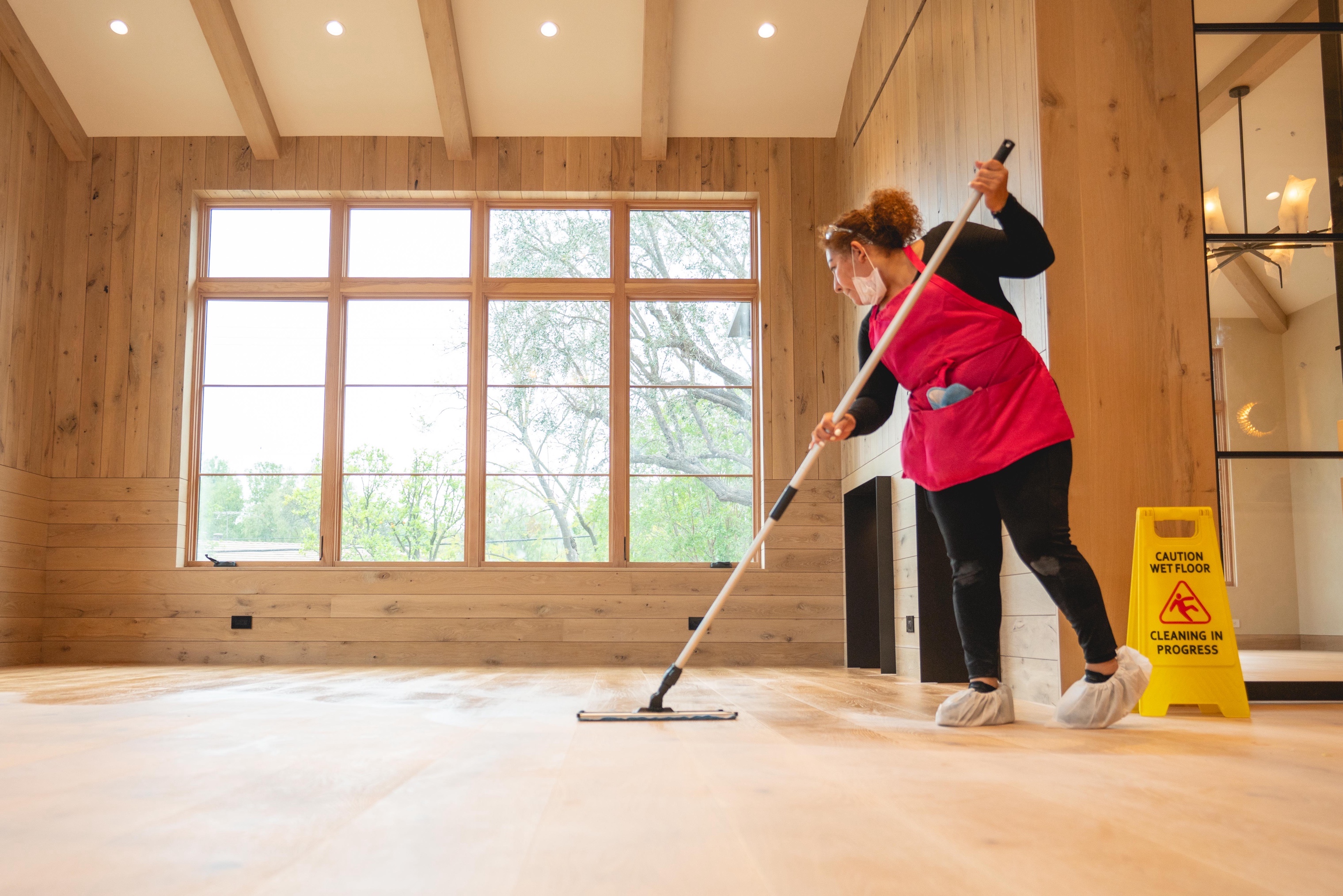
Your creative strategy must focus on before-and-after transformations. On Meta, use split-screen images or short videos showing a dirty bathroom turning sparkling clean. On Google Search, test ad copy that highlights trust factors. Use phrases like "Fully Insured," "Background Checked Cleaners," and "Next-Day Availability."
Testing these different creatives lowers your lead costs. When an ad has a great video of a transformation, people click it more often. A high click-through rate tells Facebook your ad is good, which makes them charge you less to show it. Visual proof is the fastest way to win trust.
VI. How Much Should a Cleaning Business Spend on Advertising?
Figuring out the right budget is a huge hurdle. If you spend too little, the advertising algorithms never learn who your best customers are. Your campaigns stall, and you get frustrated and quit. If you spend too much without a plan, you risk your business's cash flow.
You should start by calculating your acceptable CPA. If a new weekly cleaning client brings you $2,000 GBP a year, you can easily afford to spend $100 GBP to acquire them. A safe starting budget is usually around $1,500 to $2,000 USD per month per platform. This gives the system enough data to optimize.
The real value of knowing your budget is peace of mind. When you know exactly how much you can spend to acquire a customer, advertising stops being a gamble. It becomes a predictable machine. You put $100 AUD in, and you get a $2,000 AUD client out.
VII. Automated Bidding Strategies
Manual bidding is too slow for the modern internet. If you try to guess the right cost-per-click for every keyword every single day, you will lose to competitors who use AI. You miss out on cheap conversions that happen in the middle of the night or on weekends.
You must implement algorithmic bidding. For Google Search, use Target CPA (tCPA) bidding. Tell Google exactly how much you want to pay for a lead, and let its system adjust your bids in real-time. For Meta, use Advantage+ campaigns to let their machine learning find the best audiences automatically.
Automated bidding aligns perfectly with how ad platforms work today. Google and Meta have millions of data points on every user. Their systems know when a user is most likely to fill out a booking form. By trusting the algorithm with automated bidding, you lower your CPA and free up your time to actually run your business.
VIII. Landing Page CRO
Sending paid traffic to a slow, confusing homepage is a disaster. If a user clicks your Google Ad for "move out cleaning" and lands on a page about commercial office cleaning, they will leave immediately. This is called a leaky bucket, and it destroys your ROAS.
You must create dedicated landing pages for your ad campaigns. This is called Conversion Rate Optimization (CRO). The page must load in under three seconds. It must have a bold headline matching the ad, a clear list of what is included in the clean, trust badges (like BBB or insurance logos), and a very simple quote request form at the top.
A high-converting landing page acts as your best salesperson. If you increase your conversion rate from 5% to 10%, you instantly cut your cost per lead in half without changing your ad spend. It is the most valuable fix you can make to your entire omnichannel strategy.
IX. Cross-Platform Retargeting Sequencing
Most people do not book a cleaner the first time they see an ad. They get distracted, their kids start crying, or they close their phone. If you do not follow up with these people, you are throwing away warm leads.
You need to build a cross-platform retargeting sequence. If someone clicks your Google Ad but does not fill out the form, you must track them. Then, show them an ad on Facebook and Instagram the next day. Offer them a small incentive, like "$20 Off Your First Deep Clean," to bring them back.
Retargeting recaptures high-intent users for pennies on the dollar. Since they already know your brand, the clicks are incredibly cheap. Sequencing your ads ensures your cleaning business stays top-of-mind until the homeowner is finally ready to pull out their credit card and book.
X. Server-Side Tracking/Attribution
Apple’s iOS updates have made tracking a nightmare. If a user clicks your Meta ad on an iPhone and books a clean, Meta might not track that conversion due to privacy blockers. Your dashboard looks empty, and you might think your ads are failing even when they are working.
The solution is implementing Server-Side Tracking. On Meta, this is called the Conversions API (CAPI). Instead of relying on a simple pixel in the browser, your website server sends the conversion data directly back to Facebook's server.
Accurate attribution is critical for algorithmic bidding. If Meta and Google can actually see which ads are driving bookings, they can find more people just like those buyers. Server-side tracking future-proofs your data, scales your ROAS, and gives you a clear picture of what is actually working.
The Essential 5-Tool Paid Media Stack 🛠️
If you want to run a professional omnichannel strategy, you need the right software. Here are the 5 essential tools for house cleaning media buying.
I. ClickCease
Type: Click Fraud Protection
Competitors often click your Google Ads to drain your daily budget. ClickCease monitors your traffic and automatically blocks IP addresses that click your ads maliciously.
- • Saves massive amounts of wasted ad spend on Google.
- • Automated IP blocking and bot detection.
- • Monthly fee can be annoying for very small budgets.
II. Unbounce
Type: Landing Page Builder
It allows you to build highly optimized landing pages without knowing how to code. You can drag and drop elements to create pages that convert clicks into cleaning leads.
- • Extremely easy to use and integrates with almost any CRM.
- • Fast page load speeds and built-in A/B testing.
- • Can be expensive for premium features.
III. Triple Whale
Type: Advanced Tracking Dashboard
It centralizes all your data from Google, Meta, and TikTok into one dashboard. It uses first-party data tracking to show you exactly which ad channel is generating your revenue.
- • Fixes broken iOS tracking and provides crystal clear ROI data.
- • Primarily built for eCommerce, so home services must adapt it slightly.
IV. GoHighLevel
Type: Marketing CRM & Automation
When a lead comes in from Facebook or Google, GoHighLevel can automatically send them a text message and email to follow up immediately.
- • Replaces multiple software subscriptions and closes leads faster.
- • The learning curve is very steep for beginners.
V. AdEspresso
Type: Ad Testing & Optimization
It allows you to create hundreds of ad variations in minutes to test which images and text work best for your cleaning services.
- • Makes split testing creative incredibly fast and easy.
- • Meta's native tools are catching up, making third-party tools less necessary for basic tasks.
Case Study 1: How Sparkle & Shine Co. Scaled ROAS on Google Ads
Sparkle & Shine Co. is an independent cleaning service based in Sydney, Australia. They were struggling with high acquisition costs on Google Ads. They were paying over $95 AUD per lead, which made their weekly cleaning services unprofitable. They were using broad match keywords and their ads were showing up for irrelevant searches.
Action The Execution:
To fix this, they completely restructured their media buying execution. First, they applied for Google Local Services Ads (LSAs) and got their Google Guarantee badge. They shifted 50% of their $3,000 AUD monthly budget to LSAs to capture immediate trust. For the remaining budget, they paused all broad match keywords and built highly specific Exact Match campaigns focusing purely on bottom-of-funnel intent like [residential cleaners Sydney] and [move out cleaning cost].
📈 The Results:
The measurable ROI was incredible. Within 60 days, their CPA dropped from $95 AUD to $38 AUD. Because they stopped paying for bad clicks, their lead volume doubled without increasing their overall ad spend. Their ROAS scaled heavily because the quality of the exact match leads turned into long-term, recurring weekly clients.
Case Study 2: How Tidy Spaces Slashed Acquisition Costs with Paid Social
Tidy Spaces, a home cleaning business in Manchester, UK, was relying entirely on referrals. They wanted to expand rapidly but found Google Ads too expensive for their limited budget. They needed a way to build local awareness and generate leads cheaply.
Action The Execution:
They decided to execute a localized Meta Advantage+ Lead Generation campaign. Instead of using stock photos, they gave their cleaners iPhones to take real before-and-after photos of extremely messy kitchens and bathrooms. They loaded these raw, authentic visuals into a Meta Lead Form ad. The ad copy simply offered a "£30 GBP Off Spring Deep Clean" for homeowners within a strict 10-mile radius.
📈 The Results:
This B2C Meta strategy slashed their acquisition costs immediately. The authentic photos created a viral effect locally, leading to high engagement. Their Cost Per Lead (CPL) dropped to just £12 GBP. Because they used Meta's native Lead Forms, users did not even have to leave the Facebook app to request a quote, which removed friction and drove massive lead volume growth.
Future-Proofing Your Ad Campaigns
The advertising industry changes very fast. You must be ready for future tracking limitations. With more privacy laws coming, you will lose more tracking data.
Implement Clean First-Party Data:
The only way to survive is to build a massive first-party email and SMS list. If you own your customer data, you do not have to rely entirely on Facebook or Google to reach them.
Embrace AI Automation:
Also, AI automation is taking over media buying. Platforms want you to use their smart algorithms. To future-proof your campaigns, you must focus less on manual button-clicking and more on feeding the machines great data. Give the AI high-quality before-and-after videos, accurate conversion tracking, and excellent landing pages, and the algorithms will do the heavy lifting for you.