Table of Contents
Let us go back to the year 2013. Delhi's Indira Gandhi indoor stadium was packed to the brim with 14,000 people. Surprisingly, this massive crowd did not show up to see a famous singer or a Bollywood star. They came to the stadium to study math.
The teacher standing in front of them was Byju Raveendran. He was a charismatic educator who had completely mastered the art of teaching. On the back of this incredible teaching talent, Raveendran was about to build India's biggest EdTech company. He called it BYJU'S. Yet, in a tragic twist of fate, he would eventually watch that exact same company completely collapse right in front of his eyes.
If you have been watching the news lately, you are probably wondering what happened to BYJU'S. How does a company reach a massive $22 billion valuation only to lose almost everything a few years later? The story of this massive rise and catastrophic fall is a masterclass in what happens when a business prioritizes blind growth over its core product.
From Middle-Class Math Teacher to Stadium Status
To understand the downfall, we have to start at the very beginning. Byju Raveendran was born in Kerala in 1980. His parents were teachers in a local government school, which gave him an early connection to education. Growing up, Raveendran had a deep attachment to two specific things. He loved sports, and he loved mathematics.
Like almost every Indian middle-class family in the 1980s and 1990s, his parents gave him two acceptable career choices. He could either be a doctor, or he could be an engineer. Raveendran chose the engineering route. He completed his degree in the year 2000 and started working in a shipping firm in 2001.
But two years later, a simple favor changed the entire trajectory of his life.
Some of his friends wanted to get admission into the prestigious Indian Institutes of Management (IIMs). To do this, they needed to crack the highly competitive CAT exam. Knowing his skills, they asked Raveendran for help. Raveendran did not just tutor his friends. He decided to take the CAT exam himself just to see how he would do. The results were staggering. Four out of the twelve friends he tutored cleared the exam, and Raveendran himself scored a perfect 100th percentile.

Despite this incredible score, he did not join an IIM. He simply went back to his shipping job. But in 2005, he decided to take the CAT exam again. Once again, he scored a perfect 100th percentile.
Word spread quickly. Raveendran became known everywhere as a serial CAT topper, and students started lining up to learn his secrets. He quickly realized that he absolutely loved teaching and wanted to do it for the rest of his life. In 2006, he launched a small tutoring program called BYJU'S Classes for CAT.
The demand was explosive. Very soon, he had to shift his classes from small rooms to massive auditoriums, teaching up to 1,200 students at a single time. He operated on a clever freemium model. The first class was completely free, and the second class onwards required payment.
His teaching style was revolutionary for the time. Indian students were largely taught to memorize facts since childhood. Raveendran, however, focused heavily on practical, conceptual learning rather than just chasing marks. This fresh approach was highly effective. Nine out of every ten students who took his free class ended up enrolling in the paid version.
Seeing this massive success, he expanded his model to four major cities: Bengaluru, Mumbai, Pune, and Chennai. During this time, he met many talented students, including his future wife, Divya Gokulnath. Many of these early students, along with Divya, would later become co-founders and early employees of BYJU'S parent company, Think and Learn Pvt. Ltd.
Going Digital and the Birth of the App
By 2009, Raveendran had expanded his physical classes to nine cities. He was working day and night, traveling constantly to teach in every city every single week. But the crowds were getting too big. With so many students in an auditorium, it was impossible for kids to ask questions. To solve this, Raveendran meticulously designed his content to automatically answer every possible doubt a student might have.
The demand kept pouring in from other cities, but Raveendran was exhausted from working 24 hours a day, seven days a week. He realized he could not be physically present everywhere at once. He needed to digitize his business.
In 2009, he utilized VSAT, a satellite-based broadcasting technology, to beam his live lectures into 45 different cities. This technological leap set the true foundation for the EdTech giant. By 2011, he officially established Think and Learn Pvt. Ltd. to expand further. He built a team of passionate teachers and, most importantly, shifted his focus toward the massive school tuition segment. At the time, there were roughly 25 crore school-going students in India.
Raveendran knew that to reach all 25 crore students, he had to be on their phones. In 2013, he secured a 50 crore funding round from the Manipal Group in exchange for 26 percent equity. He used this money to start developing a dedicated mobile application.
The team recognized that every student learns differently. Some prefer videos, some prefer text, and others need practical application. They baked all of these approaches into the app, allowing students to learn at their own comfortable pace. Furthermore, Raveendran knew he was competing with mobile games and movies for the students' attention. To make the educational content just as engaging as entertainment, he hired expert teachers, motion graphics artists, 3D designers, and even professional musicians.
The BYJU'S Learning App finally launched in 2015. Alongside the app, they sold preloaded courses on physical tablets and SD cards. The customer response was overwhelmingly positive.
This early success attracted massive attention from global investors. In June 2015, Sequoia invested $25 million into the company. The following year, in 2016, Mark Zuckerberg's organization invested an impressive $50 million. With millions of dollars flooding into their bank accounts, BYJU'S leadership shifted their entire focus to one single metric: sales.
The Controversial Sales Machine
To fuel their aggressive growth targets, BYJU'S hired hundreds of fresh engineering graduates and transformed them into a ruthless sales team. Their sales funnel was incredibly clever, but it heavily relied on psychological manipulation.
It all started with television commercials. Parents would see a BYJU'S ad and download the app for their child. A few days later, a BYJU'S salesman would call the parents and book an in-person counseling session at their home.
During this home visit, the salesman would first chat with the child about their interests and ambitions, building a friendly, personal bond. Once the child felt comfortable, the trap was set. The salesman would purposely ask the child a mathematical question they knew the child could not answer. A common example was asking, "How many points are there in a circle?"
Naturally, most young children would fail to answer this trick question. This is exactly what the salesman wanted.
The salesman would then pull out his tablet and play a highly produced video of Raveendran explaining that a circle actually has infinite points. Then, the salesman would turn to the parents and drop a heavy question. He would ask the parents how their child was ever going to pass their board exams or competitive tests if they could not even grasp such a basic concept.
This question was designed to make parents feel nervous, guilty, and terrified for their child's future. Once the parents were sufficiently anxious, the salesman pitched the BYJU'S learning app as the ultimate solution to save their child's academic career. To make the expensive package seem more appealing, they offered fake 50 percent scholarships and promised a 100 percent refund option.
If the parents still hesitated, the salesman unleashed his final trick. He would ask the child a few more difficult questions, which the child would fail. Then, he would show the child specific educational videos related to those questions. After watching the videos, the salesman asked the exact same questions again. This time, the child answered correctly.
The parents, seeing immediate improvement in real-time, were usually deeply impressed. Even the child would start begging for the shiny tablet. Finally, the parents would hand over their money, and the sale was closed.
This aggressive trick worked wonders for the company's bottom line. BYJU'S grew at lightning speed. By 2018, they officially became India's first EdTech unicorn with a valuation of over $1 billion. By March 2020, they boasted nearly 4 crore users, and their valuation soared to nearly $8 billion.
And then, the entire world shut down.
The Pandemic Boom and the Funding Bubble
The COVID-19 pandemic forced the entire country of India into a strict lockdown. Schools were completely shut, and students had no choice but to rely on online education.
Seeing a golden opportunity to capture the market, BYJU'S boldly made its classes free for a few weeks. This massive sampling strategy caused their app usage to skyrocket by 60 percent. As the lockdowns extended from weeks into months, the nationwide adoption of e-learning exploded.
This explosive, unprecedented growth created a massive wave of Fear Of Missing Out (FOMO) among global venture capital investors. They were desperate to dump money into the EdTech industry so they would not miss out on the returns.
The numbers were staggering. In 2019, the entire Indian EdTech sector received a total investment of $429 million. In 2020, that number jumped to $2,220 million. By 2021, investors poured an unbelievable $4,165 million into the sector.

The most shocking part? Almost 50 percent of all that funding went directly to BYJU'S.
Armed with billions in fresh capital, BYJU'S went on an aggressive shopping spree. They started acquiring smaller EdTech startups at incredibly high prices. To enter the coding education space, they bought WhiteHat Jr for a whopping $300 million. They also bought up companies like Tynker, Toppr, Great Learning, Epic, Scholar, and GradeUp. Because three of these startups were based in the USA, Raveendran hoped to use them as a foothold to conquer the American market.
To fund these massive acquisitions, BYJU'S took on a massive $1.2 billion loan.
The climax of this spending spree was the acquisition of Aakash Institute. BYJU'S, a company that had only been around for a few years, bought out a 33-year-old traditional coaching giant for $1 billion. Financial experts noted that BYJU'S likely overpaid, offering 20 to 30 percent more than Aakash was actually worth.
By March 2022, BYJU'S had reached its absolute peak. They had 58,000 employees and a jaw-dropping valuation of $22 billion. But there was a massive problem looming just over the horizon.
The pandemic was finally ending.
The Toxic Culture and the Sales Collapse
As the World Health Organization declared an end to the global health emergency, students began returning to physical classrooms. BYJU'S hyper-growth story hit a brick wall.
The company's biggest issue was that its actual sales were barely growing compared to its inflated $22 billion valuation. Desperate to justify their price tag to investors, leadership started building immense, unbearable pressure on their sales teams.
Reports from the Bengaluru office painted a toxic picture. Employees were forced to work grueling 14-hour shifts. Sales representatives were forbidden from taking lunch breaks if they had not met their daily targets. If a potential customer simply stopped answering the phone, the entire blame was placed squarely on the salesperson.
The targets were also completely unreasonable. Every single salesman was expected to bring in 1.5 lakh in sales every single week. In 2022, the company introduced a ruthless new rule. If any salesman failed to meet at least 50 percent of their target, they would be fired immediately.
Faced with losing their jobs, the sales teams resorted to desperate measures. Incidents of severe mis-selling flooded the internet. Sales reps admitted to pressuring parents, giving them false information, and actively intimidating them into closing deals. In some heartbreaking cases, salespeople were so desperate to hit their quotas that they paid the 15,000 rupee down payments for the tablets out of their own personal pockets.
Furthermore, customers complained that when they tried to utilize the promised 100 percent refund policy, canceling their subscriptions was nearly impossible. As these stories of customer exploitation became public, the trust that Indian parents once had in BYJU'S completely evaporated.
Broken Economics and the Failed Offline Pivot
While the toxic sales culture was destroying their reputation, the top management was completely ignoring a much bigger mathematical problem. Even when they successfully closed a sale, they were losing money. Their unit economics simply did not make any sense.
On average, a salesman brought in 2.76 lakh in sales per month, including returns and cancellations. However, once the company deducted the salesman's salary, incentives, and travel expenses, the net revenue dropped to just 1.6 lakh per salesman. Once they accounted for the massive marketing and product costs, the margin shrank to a tiny 57,000 rupees. Finally, after paying for office rent, managerial salaries, and other overheads, BYJU'S was operating at a massive loss on almost every transaction.
To stop the bleeding, BYJU'S tweaked its model in late 2022. They stopped sending salesmen to people's homes for field visits. Instead, they forced the team to close deals entirely over the phone or via Zoom calls. While this successfully reduced travel expenses, it also caused their overall sales to plummet because phone calls have much lower conversion rates than in-person guilt trips.
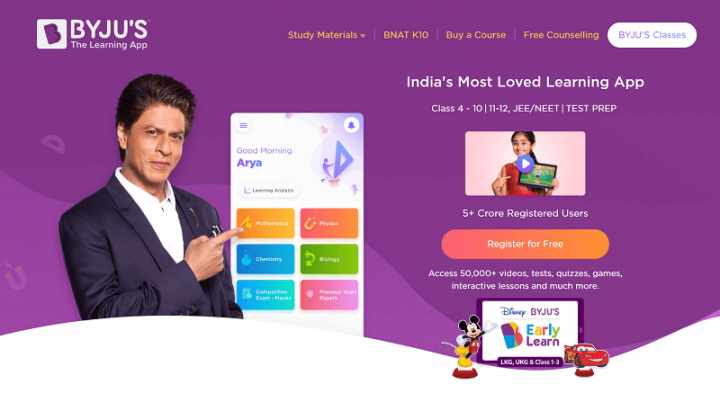
Realizing that the online model was failing them, BYJU'S made a shocking announcement in late 2022. The company that promised to digitize Indian education announced it was investing $200 million to open 500 physical, offline tuition centers across the country.
Why would they do this? Because parents and students were completely exhausted by online learning.
BYJU'S assumed that the pandemic had permanently changed consumer behavior. They were wrong. After two years of staring at screens, students were tired. Parents quickly realized that their kids were easily distracted on tablets, frequently chatting with friends, checking social media, or watching YouTube instead of studying.
Offline classes removed those digital distractions. More importantly, physical classrooms provided a level of direct accountability with a human teacher that simply did not exist on an iPad. The students went back to physical coaching centers. BYJU'S realized far too late that the billions of dollars they spent building a purely online model was fundamentally flawed.
The Earnings Report That Destroyed an Empire
The final nail in the coffin came in September 2022 when BYJU'S finally released its audited earnings report for the 2021 financial year. The numbers shocked the financial world.
Between April 2020 and March 2021, BYJU'S generated 2,428 crores in revenue. However, their losses were nearly double that amount, sitting at a staggering 4,564 crores. To put that into perspective, they were losing 12.5 crores every single day.
But the most damning detail in the report was the source of their revenue. A massive 80 percent of their income came strictly from selling physical tablets. Only 20 percent came from actual course fees and streaming. The report exposed a bitter truth to the investors. BYJU'S was not a revolutionary EdTech company at all. They were just a highly unprofitable hardware company selling tablets.
Once this truth was exposed, a mountain of problems crashed down on Raveendran.
The venture capitalists who were throwing millions at the company just a year prior completely vanished. No one wanted to touch BYJU'S. Without fresh funding, their bank accounts ran dry. Employee salaries were delayed. Vendor payments were completely stalled for months.
Then, the legal nightmare began. The US-based lenders who had provided the $1.2 billion loan sued BYJU'S for defaulting and violating the terms of their agreement. The lenders demanded full control of all BYJU'S assets and subsidiaries.
In April 2023, the Indian Ministry of Corporate Affairs launched an official investigation into the company's financial and corporate governance practices. Desperate to survive, BYJU'S began conducting mass layoffs. According to EPFO data, their workforce dropped from 58,000 employees in March 2022 to less than 25,000 by June 2023.
They also started selling off their prized acquisitions at massive losses. They announced the sale of the US-based platform Epic for $500 million. Considering they originally bought Epic for $1 billion, they took a half-billion-dollar loss on a single asset.
The bad news just kept coming. In September 2023, the BCCI started insolvency proceedings against the company due to nonpayment. A month later, the Enforcement Directorate issued notices accusing BYJU'S of 9,000 crore in FEMA violations.
Under the weight of all these scandals, the company's valuation completely cratered. In January 2024, BYJU'S valuation was slashed down to just $225 million. Their value had dropped by an unbelievable 99 percent from its peak. In terms of rupees, the company had incinerated roughly 1,80,000 crore in wealth.
Frequently Asked Questions
What happened to BYJU'S?
Who is the founder of BYJU'S?
Why did BYJU'S buy Aakash Institute?
Why did BYJU'S start opening offline tuition centers?
How much money did BYJU'S lose?
Were BYJU'S sales tactics unethical?
Conclusion
Today, aside from their main office in Bengaluru, BYJU'S has reportedly emptied all of its other offices across India. Acquiring new paid users is incredibly difficult, their offline tuition centers failed to gain traction, and almost all of the expensive startups they acquired are operating at a loss. The ultimate lesson behind what happened to BYJU'S is incredibly clear. A company that claimed to revolutionize Indian education completely lost sight of its actual product. By letting an addiction to growth and sky-high valuations replace their core focus on education, they orchestrated their own inevitable downfall.