Table of Contents
Getting off the couch to log miles on the pavement is a brutal mental hurdle for most Americans. The monotony of standard cardio is exactly why treadmills inevitably become expensive clothing racks. But what if running outside felt less like a chore and more like a massive, city-wide video game?

Enter Card.io, a startup that marched into the Shark Tank with a radical pitch: to do for running what Pokémon GO did for walking.
With a compelling backstory involving living out of a car and relentless cold-emailing, this pitch delivered one of the most emotional negotiations of Season 16. But the tech world is ruthless, and scaling an app requires more than just a heartwarming story.
What is Card.io?
Card.io is a gamified, location-based fitness application designed to make cardiovascular exercise intensely competitive and highly social. Instead of simply logging miles or tracking heart rates, the app transforms your local neighborhood into a virtual game board.
Users join teams and engage in a massive "turf war," claiming actual city blocks for their squad by walking, running, or cycling through them. The interactive map updates in real-time, meaning a rival runner can swoop in and steal your territory while you sleep.
By merging the addictive habit loops of mobile gaming with physical exertion, Card.io targets the millions of people who find traditional exercise deeply boring. The app seamlessly integrates with major fitness wearables and platforms like Apple Health, Garmin, and Strava, ensuring users get credit for every step.
| Feature | Details |
|---|---|
| Industry | Health & Fitness Tech |
| Founded Year | 2022 |
| Core Product | Gamified Cardio Fitness App |
| Target Audience | Runners, Walkers, and Fitness Enthusiasts |
| Retail Price | Free (Basic), $25/month (Premium Run Clubs) |
Who is the Founder of Card.io?
Destin George Bell, a Louisville, Kentucky native and University of Kentucky Gatton College alum, is the brains behind the operation. Like many former athletes, Bell found that once his competitive basketball days ended, his motivation to simply run for the sake of health plummeted.
During the COVID-19 pandemic, Bell found himself completely broke, living out of his car in Austin, Texas, and sinking into a sluggish routine.
He needed a way to make exercise engaging again. Inspired by the massive global phenomenon of Pokémon GO, he envisioned a fitness app that tapped into that same augmented-reality magic. The problem? Bell was a marketing guy, not a software engineer, and he had zero capital.
Displaying an incredible level of hustle, Bell reached out to 400 different software engineers. Only one responded, a founding engineer from Pokémon GO. That connection yielded the email address of John Hanke, the CEO of Niantic. Bell relentlessly cold-emailed Hanke every single week until he finally secured a meeting, which ultimately led to $150,000 in non-dilutive grants to build the initial prototype of Card.io.
Card.io Shark Tank Journey & Pitch
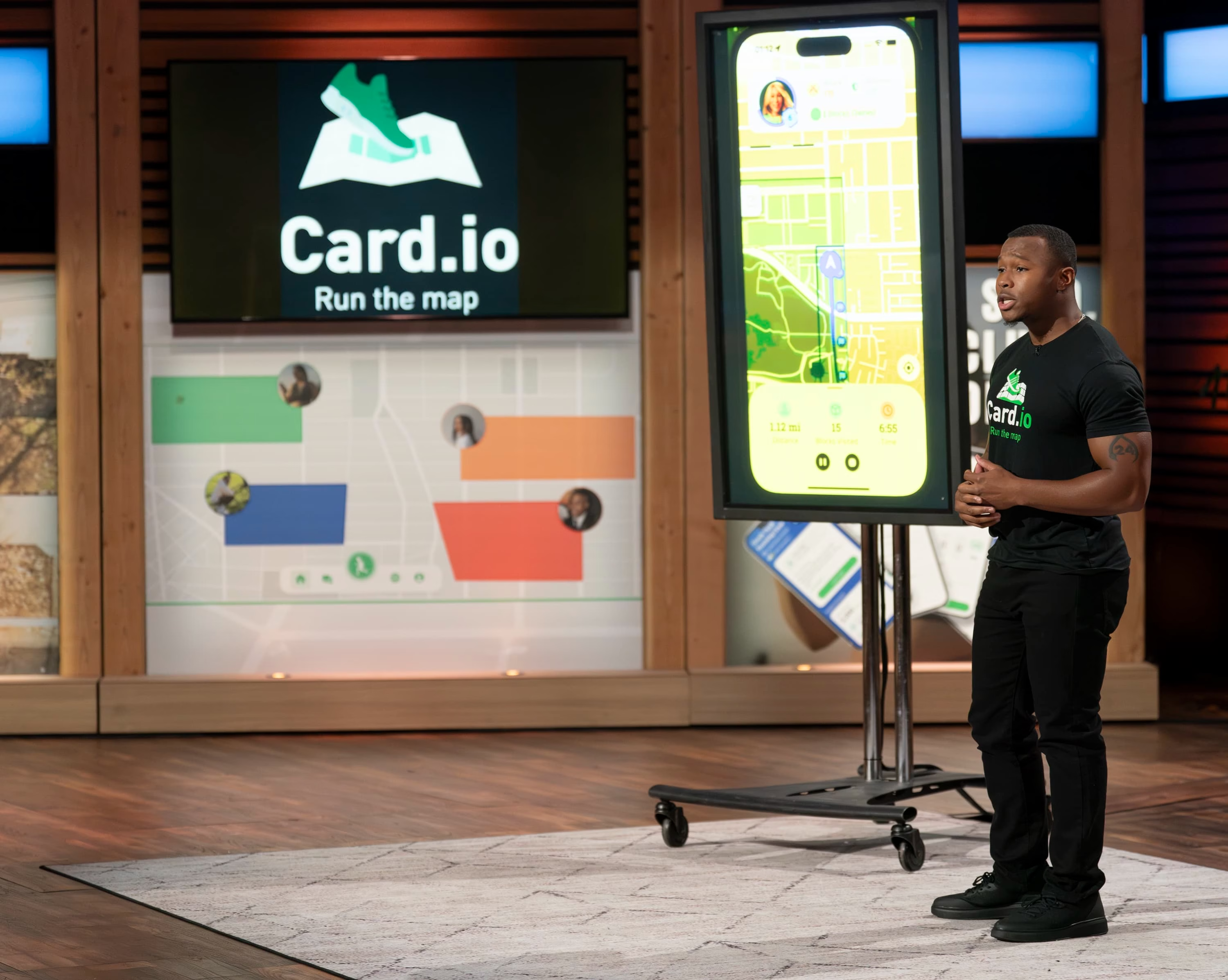
Bell walked into Season 16, Episode 1 of Shark Tank with undeniable swagger, seeking a $150,000 investment in exchange for 5% equity. He delivered a flawless presentation, demonstrating how the app's turf war mechanics functioned and highlighting the 22,000 users he had already acquired across 70 countries.
However, the mood shifted when the financial realities of the software business were laid bare. Despite raising $470,000 through various grants, the app was operating on a "freemium" model and had only pulled in a meager $4,000 in revenue the month prior to filming.
Lori Greiner bowed out quickly, noting she simply wasn't the target demographic for running or gaming. Kevin O'Leary, ruthlessly analytical as always, could not justify a $3 million valuation for a company generating a few thousand dollars a month, and dropped out. Mark Cuban also passed, feeling he wasn't the right strategic partner to scale the user base.
But Guest Shark Rashaun Williams (a seasoned software investor) and Daymond John saw past the raw numbers. Daymond was visibly moved by Bell's story of living in his car and his sheer entrepreneurial grit. The two Sharks teamed up, but they demanded a much larger slice of the pie.
| Pitch Detail | Information |
|---|---|
| Initial Ask | $150,000 for 5% Equity |
| Implied Valuation | $3 Million |
| Sharks in the Room | Mark Cuban, Kevin O'Leary, Lori Greiner, Daymond John, Rashaun Williams |
| Offers Made | Daymond John & Rashaun Williams: $150,000 for 15% |
| Final Deal | $150,000 for 15% (Accepted) |
Bell attempted to counter at 10%, but the Sharks held firm. In a rare Shark Tank moment, Bell asked to bring his mother, Sharon, out from backstage. After a quick huddle, she looked at her son and told him to take the deal. Bell happily accepted the joint offer.
What Happened to Card.io After Shark Tank?

The immediate aftermath of the broadcast delivered the legendary "Shark Tank Effect." Thousands of eager users flooded the iOS App Store, completely overwhelming Card.io's servers. The rapid influx of traffic caused significant technical bugs, prompting users to take to Reddit to complain about crashes and unlogged miles.
Rather than hiding behind a corporate PR wall, Bell actively engaged with frustrated users on Reddit under the handle Gfortune_500. He apologized for the rushed UI updates, explained the server constraints, and rapidly pushed out major software patches to stabilize the platform.
With the $150,000 capital injection and the strategic guidance of Williams and John, the company immediately went to work scaling their infrastructure.
By early 2025, they launched a highly requested Android version, opening the floodgates to an entirely new demographic of users. They also rolled out vital updates, including "Ghost Mode" to protect runner privacy and in-app team chat functionalities to strengthen the community aspect of the turf wars.
Is Card.io Still in Business?
Yes, Card.io is very much in business and actively growing. The app has successfully navigated the dangerous post-Shark Tank waters where many software startups sink due to scaling issues.
Today, Card.io boasts over 40,000 active users spanning 80 different countries. They have secured official partnerships with major running organizations, including the Cleveland Marathon and the Road Runners Club of America.
Furthermore, they have expanded their revenue streams beyond the standard $25/month premium subscription by tapping into corporate wellness programs, successfully piloting a program with Oracle's Austin corporate office to get tech employees moving.
What is the Valuation & Net Worth of Card.io?
Determining the exact valuation of a privately held, early-stage tech startup can be tricky. When Destin George Bell accepted the deal from Daymond John and Rashaun Williams, the company's valuation was effectively slashed from his initial $3 million projection down to a hard $1 million.
Based on their expanded user base of 40,000+, successful Android launch, and entry into B2B corporate wellness programs, industry estimates place the current valuation of Card.io between $1.5 million and $2.5 million.
Because Bell retains a massive majority stake in his company (even after giving up 15% to the Sharks and any minor equity to early advisors), his personal estimated net worth sits comfortably around the $1 million to $1.5 million mark. It is a staggering financial turnaround for an entrepreneur who was sleeping in his car just a few years prior.
Card.io App Reviews: Is the Gamified Cardio App Good?
If you check the App Store or Google Play in 2026, user sentiment is generally highly positive, though it reflects the growing pains of a young startup. Early adopters heavily criticized the intrusive ads on the free tier and the initial technical bugs that failed to capture run data.
However, recent reviews highlight the massive improvements the development team has made. Fitness enthusiasts praise the "turf war" concept as highly addictive, noting that the desire to reclaim a stolen neighborhood block from a rival team has forced them out of bed for a 6 AM run more than once.
The integration with Garmin and Apple Health is frequently cited as the app's strongest technical feature, allowing serious runners to maintain their standard data tracking while still participating in the game.
Top Card.io Alternatives
If you are looking for ways to gamify your fitness routine but Card.io doesn't quite fit your style, there are a few heavy-hitting alternatives on the market:
- Zombies, Run!: The undisputed king of narrative fitness. This app plays audio over your music, placing you in the center of a zombie apocalypse where you must literally run faster when you hear the undead approaching.
- Strava: While not a "game" in the traditional sense, Strava's leaderboard segments create intense, real-world competition among local runners and cyclists fighting for the "Local Legend" crown.
- Pokémon GO: The app that inspired it all. While originally designed for casual walking, dedicated players still use it to log serious mileage while hunting for rare catches.