
Table of Contents
If you walk into any pediatrician’s waiting room, airport terminal, or family restaurant today, you will likely see the exact same thing: children sitting in total silence, staring down at glowing tablet screens. Screen time has completely taken over modern childhood, leaving active, physical play in the dust. That is exactly what husband-and-wife gymnastics coaches Tim and Kaity Wade saw happening in the waiting area of their own gym.
Refusing to watch another generation become iPad zombies, they created a massive, interactive, and completely screen-free solution. They brought their high-energy invention to Shark Tank Season 17, Episode 15, hoping to land an investor. But as many entrepreneurs find out, having a noble mission doesn't always guarantee a deal in the Tank.
What is Everything Blocks?
Everything Blocks are giant, lightweight, educational building blocks designed to make learning a physical and engaging activity for children. Unlike traditional heavy wooden blocks or permanent foam pit cubes that take up half a playroom, Everything Blocks feature a unique "Fold and Forget" design.
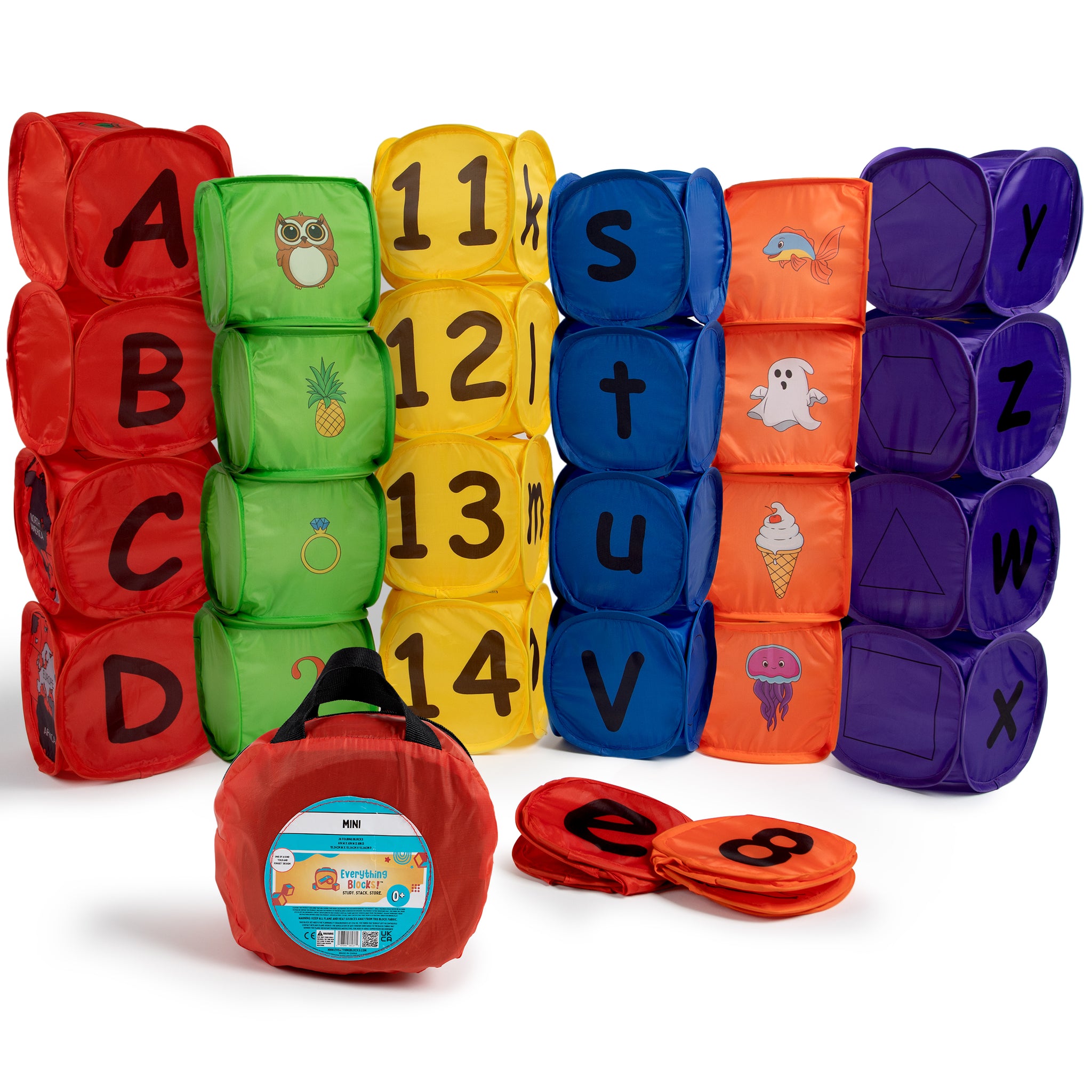
Made from durable, lightweight vinyl, these blocks can be popped open for giant stacking sessions and then collapsed completely flat to fit into a convenient carrying bag. They are designed to be safe for ages zero and up, making them a perfect addition for toddlers, pre-K students, and elementary kids.
But these are not just blank boxes. Every single block is a learning tool. A standard set includes 26 blocks that cover the full alphabet in both UPPERCASE and lowercase letters, phonics pictures to help kids sound out words, and numbers from 0 to 20 for early math skills.
Furthermore, the blocks feature a world map puzzle that kids can build vertically. It is a highly interactive toy that forces kids to stand up, reach, stack, and move around while they learn their ABCs and 123s. Currently, the company sells two main variations: the 6-inch "Mini" set and the massive 12-inch "Original" set, with options to buy combo packs for mixed-and-matched buildings.
| Business Overview | Details |
|---|---|
| Industry | Children's Educational Toys |
| Founders | Tim and Kaity Wade |
| Core Product | Giant, collapsible vinyl learning blocks |
| Target Audience | Parents, Teachers, Pre-K to Elementary Kids |
| Retail Price | $79.99 (Mini Set) - $159.99 (Combo Set) |
| Key Features | Fold-flat design, Letters, Numbers, World Map |
Who is the Founder of Everything Blocks?
Everything Blocks was founded by Tim and Kaity Wade, a married couple based in Texas who have been partners in both life and business for years. Before entering the grueling world of retail toys, Tim and Kaity spent a decade working as gymnastics coaches.
During their time coaching, they observed two very distinct things. First, they noticed how much the young athletes absolutely loved playing with the giant 8-inch foam blocks used in the gym's crash pits. Kids would spend hours pulling them out, stacking them into giant towers, and knocking them down. Second, they noticed the stark contrast in the gym's waiting room, where siblings of the athletes would sit motionless for hours on digital devices.
Tim and Kaity realized that parents actually wanted their kids to engage in the kind of large-scale, physical play they saw in the gym. The problem was logistics. No normal parent has the closet space to store twenty-six 12-inch foam blocks in their living room.
The lightbulb went off. What if they could create a giant block that was hollow, durable, and could fold completely flat? They poured their life savings into the idea. To fund their initial manufacturing runs and get the business off the ground, they even took out a massive line of credit backed by Tim's family gymnastics gym. It was a massive gamble, but their coaching background gave them the relentless drive needed to push the product to market.
Everything Blocks Shark Tank Journey & Pitch
Tim and Kaity stepped onto the famous carpet during Season 17, Episode 15, which aired in the spring of 2026. Knowing they had to grab the Sharks' attention immediately, they brought their infectious coaching energy straight into the Tank.
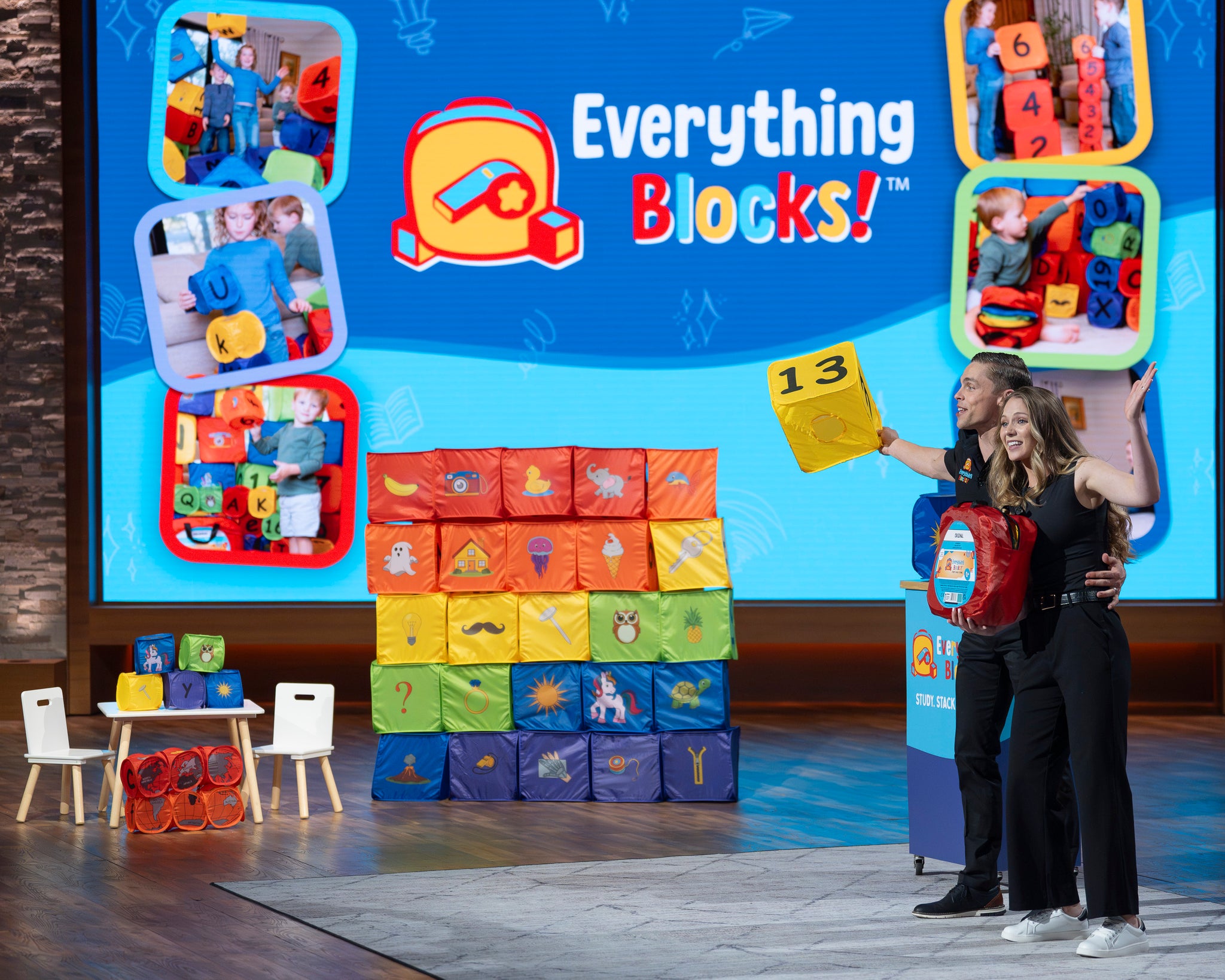
They didn't just stand there and give a boring financial lecture; they invited the Sharks to get out of their seats, interact with the giant blocks, and see the "Fold and Forget" mechanism in person. The Sharks were instantly impressed by the energy and the clear problem the product solved. The demonstration proved that the blocks were indeed lightweight, safe, and incredibly easy to pack away.
When the conversation shifted to the numbers, Tim and Kaity proudly defended their hustle. They revealed that in their very first year of business, they generated $100,000 in sales. In the trailing 12 months leading up to their pitch, they had accelerated that number to an impressive $352,000. For a totally self-funded, independent toy brand, these numbers were rock solid.
However, the mood in the Tank shifted when the Sharks started digging into the brutal realities of the global toy industry. Kevin O'Leary and Lori Greiner quickly voiced major concerns. First, they questioned the retail pricing. At almost $100 for a full-size set, they worried the product might be priced out of the casual gifting market, making it an expensive luxury item rather than a mass-market impulse buy.
| Pitch & Offers | Details |
|---|---|
| Season & Episode | Season 17, Episode 15 (2026) |
| Entrepreneurs | Tim and Kaity Wade |
| Trailing 12-Month Sales | $352,000 |
| Sharks in the Room | Mark Cuban, Kevin O'Leary, Lori Greiner, etc. |
| Main Shark Concerns | High retail price point, patent defensibility, knockoff risk |
| Final Deal Accepted | No Deal (Walked Away) |
Second, the Sharks hammered them on intellectual property. While the "pop-open" folding design was clever, the Sharks feared it was not defensible enough against overseas manufacturing giants. They worried that massive foreign retailers (like Temu or Amazon drop-shippers) could easily reverse-engineer the folding nylon fabric concept and flood the market with cheap $15 knockoffs.
Ultimately, the Sharks felt the toy business was simply too cutthroat, too reliant on massive inventory costs, and too easy to copy. Despite praising Tim and Kaity's incredible work ethic and sales numbers, all the Sharks dropped out. The couple walked out of the Tank without an investor.
What Happened to Everything Blocks After Shark Tank?
Leaving the Tank without a deal is often viewed as a failure, but in the modern era of Shark Tank, the broadcast itself is worth its weight in gold. As soon as Episode 15 aired, Everything Blocks experienced the legendary "Shark Tank Effect."
Millions of parents watching at home saw exactly what Tim and Kaity saw in their gym: a fun, educational way to get their kids off the couch. The idea of a giant toy that doesn't permanently ruin the aesthetic of a living room resonated deeply with American families. Traffic to their website exploded overnight.
Following the show, the couple leaned heavily into their educational angle. They began partnering with top online educators and influencers to offer free, printable lesson plans on their website. By showing parents exactly how to use the blocks for math, spelling, and geography, they transformed the product from a simple stacking toy into a legitimate homeschooling and early-childhood education tool.
Despite the Sharks' warnings about cheap knockoffs, the Wade family's head start in the market and their high-quality vinyl materials kept their brand strong. While online forums like Reddit debated whether the product could be knocked off by cheap overseas sites, paying customers left glowing reviews praising the durability and the bright, engaging colors.
Is Everything Blocks Still in Business?
Yes, Everything Blocks is very much still in business and thriving. They did exactly what smart entrepreneurs do after a reality TV appearance: they capitalized on the momentum.
Currently, the company sells directly to consumers through their official website. The demand generated by the show has kept their inventory moving at a rapid pace. As of today, the 6-inch "Mini" sets are fully in stock and shipping same-day out of their Texas warehouse. The massive 12-inch "Original" sets proved to be so popular after the broadcast that they completely sold out; the company currently has them on a pre-order waitlist slated for delivery in July 2026.
They have also introduced promotional pricing to combat the Sharks' concerns about cost, lowering the Mini sets to $59.99 and the Original sets to $79.99, which has drastically helped conversion rates on their website.
What is the Valuation & Net Worth of Everything Blocks?
Because Tim and Kaity Wade did not accept a deal on Shark Tank, there is no public, contracted valuation for Everything Blocks. However, we can estimate their financial standing based on their broadcast numbers and standard industry multiples.
During the pitch, the founders confirmed $352,000 in trailing 12-month sales. With the massive television exposure from ABC, standard post-show revenue bumps typically see companies double or triple their baseline sales in the following year if inventory holds up. Assuming Everything Blocks clears between $600,000 and $800,000 in revenue for 2026, the company's valuation would conservatively sit between $1 Million and $1.5 Million.
As for the founders, Tim and Kaity maintain 100% equity in their business. Since they are actively reinvesting profits to fund their massive manufacturing run, their liquid net worth might be tied up in the company, but the estimated net worth of the Everything Blocks brand is a solid, growing seven-figure asset.
Where to Buy Everything Blocks?
If you are looking to get your hands on these giant folding blocks, the only place to currently purchase them is directly through the official Everything Blocks website (everythingblocks.com). By keeping their sales Direct-to-Consumer (DTC), Tim and Kaity are able to avoid standard retail markups and keep their margins healthy. All orders ship directly from their fulfillment center in Texas, and every set comes with a lifetime warranty, proving that the founders stand behind the durability of their vinyl design.
Everything Blocks Alternatives
If the pre-order waitlist for Everything Blocks is too long, or if the price point is slightly out of budget, there are a few alternatives on the market, though none offer the exact "Fold and Forget" technology.
-
Magna-Tiles: The gold standard for modern kids' building toys. While they don't offer the giant, full-body physical movement of Everything Blocks, they are incredibly popular for spatial learning and store relatively easily.
-
Cardboard Brick Blocks: Brands like Melissa & Doug offer giant blocks made of heavy-duty cardboard. They are much cheaper than vinyl, but they cannot be folded down once assembled, meaning they take up a massive amount of permanent space in your home.
-
Standard Foam Pit Blocks: You can purchase standard 8-inch polyurethane foam blocks online. While they are soft and fun to jump into, they lack printed educational letters or numbers, and they are notorious dust-magnets that are impossible to store away cleanly.