
A pool is one of the largest purchases a homeowner will make, $50,000 to $150,000 depending on the build. Before anyone calls a contractor, they research online. If your business doesn't appear in that research phase, you don't exist as a candidate, no matter how good your work is.
Unlike paid ads, local SEO builds compounding visibility. A well-optimized Google Business Profile keeps generating calls without ongoing spend. It also builds purchase confidence before a homeowner ever contacts you: seeing your business ranked at the top, with verified photos of past builds and recent reviews, removes a lot of the anxiety that comes with a five-figure home project.
Google's goal is to surface the most trustworthy, geographically relevant option. Your job is to prove that's you.
💡 The Marketing Trifecta
While SEO delivers long-term traffic, it should always be paired with a strong paid and social foundation. Don't forget to implement our Complete Pool Builder PPC Strategy for instant local leads, and utilize our Pool Builder Social Media Marketing Guide to build community trust before a client even calls you!
📊 The Current Local Search Landscape for Pool Builders
Local search has gotten more specific. Homeowners don't type "pool company" anymore. They search for "fiberglass pool builders near me" or "gunite pool installation in [City]." Google has gotten much better at matching that specific intent to businesses with matching signals.
What are those signals? Reviews, photos with geographic data, consistent business listings across the web, localized page content, and a fully built-out Google Business Profile. If your digital footprint is thin on any of these, Google simply passes you over for a competitor who has them covered.
The good news: most pool builders in any given market haven't done this work thoroughly. There's usually a gap at positions 1–3 in the Map Pack waiting to be filled.
The 10-Step Local SEO Blueprint for Pool Builders
I. GBP Optimization & Verification
The most common GBP mistake isn't having a bad profile, it's having an abandoned one. Many contractors set up their profile years ago, left the description blank, picked a generic category, and never touched it again. An incomplete profile tells Google you're not active, and it tells homeowners they can't verify your business details.
Fix it section by section. Set your primary category to "Swimming pool contractor." Add secondary categories if you also handle maintenance or supply sales. Upload your logo and at least 10 photos of completed builds. Write a business description that names your specialty and service area. Use the Google Posts feature to share recent projects, seasonal offers, or maintenance tips, this signals to Google that the profile is actively managed.
A fully built-out GBP is the single highest-leverage action in local SEO. It directly influences whether Google includes you in the Map Pack, and it's the first thing a homeowner sees before they decide to call.
II. NAP Consistency & Citation Building
If your business name, address, or phone number is listed differently across Yelp, Facebook, your website, and Houzz, Google loses confidence in your data. Inconsistencies don't just confuse customers, they actively suppress local rankings.
Run a citation audit first. Use a tool like Whitespark or BrightLocal to pull every mention of your business online and flag mismatches. Fix the errors, then build new citations on high-authority platforms: Better Business Bureau, Houzz, Yelp, HomeAdvisor, and your local Chamber of Commerce. Use your exact legal business name and local phone number (NAP Consistency) everywhere, no abbreviations, no formatting variations.
Consistent citations are verification signals. They tell Google that a real business operates exactly where it claims to. The payoff is direct: more consistent your data, the more confidently Google surfaces you.
III. Localized On-Page SEO (City & Service Pages)
One generic Services page won't rank across a 30-mile service radius. If a homeowner in a city 20 miles away searches "pool builders near me," your generic page has no local relevance to that search.
Build individual landing pages for each city you serve, structured by service type: "Custom Concrete Pools in Orlando, FL," "Fiberglass Pool Installation in Kissimmee, FL." Each page needs unique content, not the same copy with the city name swapped. Reference local weather conditions, building codes in that county, or specific neighborhoods where you've completed projects. Describe the work you've actually done in that area.
These pages let you rank in markets you're already serving. A pool builder with 12 city-service pages can show up in 12 different local markets simultaneously. Each page is a separate entry point.
Best Practice: Geo-Tagging Your Project Photos
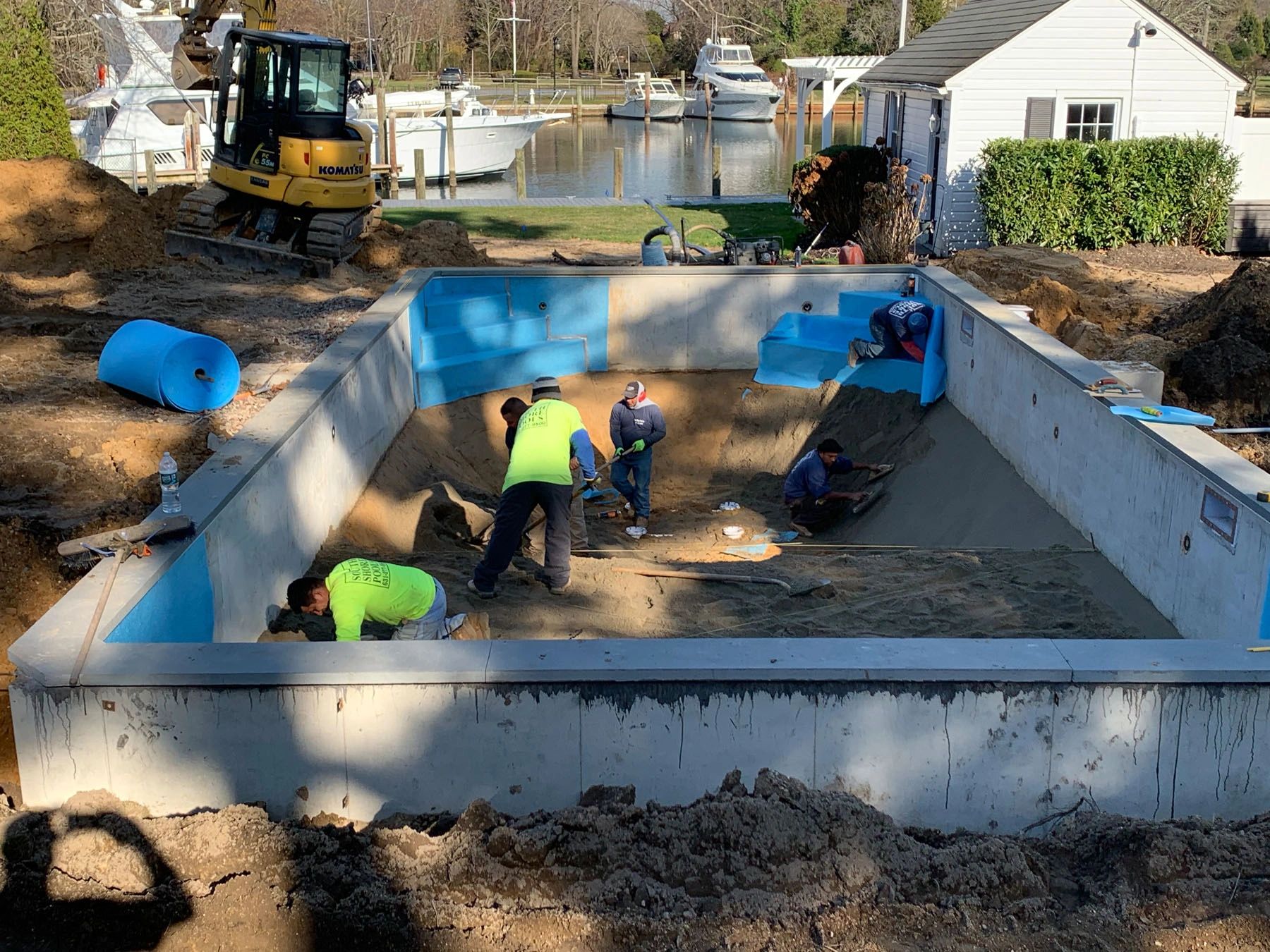
Most builders take good photos of completed pools but upload them without geographic data. Search engines can't see the pool, they can only read the file metadata. A photo named "IMG_4821.jpg" with no GPS data does nothing for local SEO. Before uploading any project photo, use a tool like GeoImgr to embed the GPS coordinates of the job site. Rename the file descriptively: "fiberglass-pool-installation-dallas-tx.jpg." Upload it to both your website and GBP. When Google crawls your site and sees dozens of photos tagged to specific neighborhoods, it confirms your actual service area. This is one of the most underused local SEO tactics in the home services space.
IV. Review Generation & Reputation Management
A two-year-old review profile tells potential clients your business may be inactive. More specifically, recent review velocity is a ranking factor for the Map Pack, Google weighs how recently and how often you're receiving reviews, not just the star average.
Build a simple follow-up system: send an SMS or email to clients within 48 hours of pool completion, when satisfaction is highest. Make the request specific and easy, one link directly to your Google review page. Respond to every review, positive or negative. A thoughtful response to a negative review often does more for purchase confidence than five five-star reviews with no replies.
Review management isn't just about rankings. For a $100,000+ purchase, a homeowner needs to trust you before they call. A consistent, recent review record removes the risk from that decision.
V. Service Area Settings & Address Management
If you operate without a physical showroom, common for pool builders working out of a home office, displaying your residential address on GBP violates Google's guidelines. A violation can trigger a profile suspension, which means zero Map Pack visibility until it's resolved.
The fix is straightforward. Log into GBP, clear the physical address field, and configure your Service Areas by city, county, or zip code instead. Select every area where you actively build pools.
This keeps your account compliant and still allows you to appear in searches across your full service radius. Don't skip this step, a suspended profile mid-season has real business consequences.
Can the same SEO strategy work for both residential and commercial pools?
Yes, but only if you separate them. A hotel facilities manager searching for a commercial pool contractor and a homeowner searching for a backyard pool are using completely different search terms and have completely different buying criteria. A single page trying to serve both audiences will rank poorly for both. Build dedicated silos: a "Commercial Pool Construction" section optimized for terms like "hotel pool contractor" or "community pool builder," and a separate "Residential Pool Installation" section. Add case studies specific to each, a 30,000-gallon municipal pool project belongs nowhere near a page targeting homeowners. Separating them also lets you rank for two distinct keyword sets simultaneously, which effectively doubles your search surface area.
VI. Local Services Ads (Google Guaranteed) Synergy
Organic rankings take three to six months to build. Local Services Ads fill the gap in the meantime.
LSA puts your business at the very top of the search results page, above the Map Pack and above organic listings, with a "Google Guaranteed" badge. You apply, pass a background check, verify your licenses, and then pay per call received, not per click. No click fraud, no paying for people who never intended to hire anyone.
The combination of LSA and organic Map Pack visibility is worth more than either alone. A homeowner who sees you at the top of the page twice, once in the guaranteed ads, once in the organic results below, is more likely to call than one who sees you once. That dual presence signals legitimacy in a way a single listing can't.
VII. Local Link Building & PR
Most pool company websites have weak domain authority because they've never acquired backlinks from other local websites. Without them, Google treats your site as isolated, not connected to the local business community, which makes it harder to outrank established competitors.
The most natural link sources for pool builders: local Chamber of Commerce membership (most include a website directory listing), landscaping companies willing to do mutual referral features, pool equipment suppliers who'll link to featured installs, and local home or real estate publications where you write a guest post on pool maintenance or design trends. Sponsoring a local youth sports team often comes with a website link.
Each local backlink is a signal that your business is a real, recognized part of the community. The combined authority of even a dozen quality local links meaningfully moves rankings.
VIII. Local Schema Markup
Local Schema Markup is a technical layer in your website's code that tells Google exactly what type of business you are, where you operate, and what your hours are, in a structured format Google reads natively rather than inferring from plain text.
For pool builders, add LocalBusiness schema that includes your business name, coordinates, service areas, business hours, and license information. If you're on WordPress, plugins like Yoast or RankMath handle most of this without custom code. For custom sites, a developer can implement it in a few hours.
Proper schema eliminates ambiguity. Google doesn't have to guess what your business does or where it operates, you've told it explicitly. This is especially useful for voice search and for businesses serving multiple cities.
IX. Apple Maps and Bing Places Optimization
Google holds about 90% of search market share, but that 10% is still real revenue. iPhone users default to Apple Maps. A significant share of office-computer searches runs through Bing.
Claim your listings on both Apple Business Register and Bing Places for Business. The process mirrors GBP: set your categories, upload photos, match your NAP to your Google profile exactly. Bing offers a direct sync from your GBP, which saves time.
These platforms also contribute citation authority that strengthens your overall local presence. The setup takes an afternoon. Ignoring them means you're invisible to a portion of homeowners already searching for what you do.
X. Grid Tracking and Reporting
Most business owners check their rankings by searching from their own office and seeing themselves at the top. That result is personalized to your location and browser history. Two miles away, you might be ranking 14th.
Local rankings shift block by block. A Grid Tracking tool drops a matrix of pins across your city and checks your Map Pack ranking at each point. The result is a heat map showing exactly where you're visible and where you're not. The gaps in that map are your next targeting priorities, new city-landing pages, additional localized citations, or fresh geo-tagged photos from projects in those specific neighborhoods.
Tools like BrightLocal and Whitespark both offer this. Run the grid report monthly and treat the weak spots as an action list, not just data.
The Essential 5-Tool Local SEO Stack 🛠️
1. Whitespark
Best for citation building and local rank tracking.
Its citation finder surfaces niche, city-specific directories that broader tools miss.
The data is highly reliable. Best for businesses managing citations manually.
The interface is dated.
2. BrightLocal
Best all-in-one platform for pool builders.
The visual grid tracker is the clearest way to see your ranking geography.
Reports are client-ready and perfectly designed.
Citation building carries a per-citation fee that adds up at scale, so use it for auditing and tracking rather than bulk submission.
3. GatherUp
Automates review requests via SMS and email.
Its best feature: it intercepts unhappy customers before they leave a public review, routing them to an internal feedback form instead.
Worth the $99/month cost if review volume is a bottleneck.
Overkill if you're only closing 5–10 jobs per year.
4. PlePer
A technical tool for GBP competitor analysis.
It extracts the exact categories and attributes your top-ranking competitors are using — including secondary categories most people never set.
Cheap, highly specific, and genuinely useful for GBP optimization.
Requires comfort with technical dashboards.
5. GeoImgr
Embeds GPS coordinates into photo EXIF data before upload.
Drag-and-drop interface, map-based coordinate selection, supports bulk processing.
Use it every time you upload project photos to your website or GBP.
The free version limits daily photo volume.
Case Study: How River Pools Dominated the Map Pack
River Pools and Spas, a Virginia-based fiberglass pool builder, hit a wall during the 2008–2009 recession. Traditional advertising spend was producing diminishing returns, and their organic search footprint was thin. They weren't showing up in local Map results outside their immediate area.
Action Their Response:
A content-led local SEO strategy. They created detailed, localized content answering every question a pool buyer could ask, cost guides, material comparisons, installation timelines, optimized for specific local search intent. They built out hyper-local service pages for every major city in their service radius and geo-tagged every completed installation photo.
📈 The Outcome:
The outcome was documented in their own public case studies: organic traffic increased by several hundred percent over several years, Map Pack rankings spread across multiple counties, and the content strategy eventually generated enough inbound lead volume to support a national franchise expansion. The core mechanism was simple, serve the local search intent better than anyone else in each market.
Case Study: How California Pools Scaled Multi-Location SEO
California Pools operates dozens of franchise locations. Their problem was structural: inconsistent NAP data across hundreds of directory listings, and service pages that were effectively duplicates of each other with city names swapped in. Google flagged the duplicate content and suppressed rankings across multiple franchise locations simultaneously.
Action Their Fix Required Two Parallel Tracks:
First, a parent-child GBP architecture: each franchise location got its own verified profile tied to the corporate brand, with distinct categories, photos, and service descriptions. Second, API-based NAP cleanup pushed consistent business data to hundreds of directories at once. Third, each franchise page was rewritten with genuinely location-specific content, local soil conditions affecting pool construction, regional design preferences, city-specific permits and timelines.
📈 The Result:
Duplicate content penalties cleared, individual franchise locations began ranking in the Map Pack for their respective cities, and inbound call volume increased across the portfolio. The lesson is operational, not technical: multi-location SEO fails when you treat it as a copy-paste job.
Future-Proofing Your Local Visibility
Search algorithms update constantly, but the underlying signal Google is looking for hasn't changed in a decade: a real, active business with verified information, recent positive reviews, and clear local relevance.
The tactics that backfire, keyword-stuffed business names, fake location listings, purchased reviews, all fail for the same reason. They fake the signals Google wants instead of building the real thing. Algorithm updates are specifically designed to find and penalize that.
Focus on E-E-A-T: Experience, Expertise, Authoritativeness, and Trustworthiness. Keep your GBP data accurate. Photograph and geo-tag every build. Ask for reviews after every completed job. Add content that demonstrates you've actually worked in the markets you claim to serve. If you're starting from zero, fix your GBP first. Everything else, citations, schema, grid tracking, compounds off that foundation.