Table of Contents
For centuries, classical string instruments have been built exactly the same way. Luthiers spend months painstakingly carving, sanding, and varnishing fragile, temperamental wood. The result? A beautiful instrument that sounds like heaven, costs as much as a luxury car, and cracks if the room gets a little too dry. For touring musicians lugging their gear through airports, or for parents trying to afford a decent student cello, the traditional music industry has always presented a massive, expensive barrier to entry.
Enter Forte3D. When a veteran instrument builder, a Yale engineering student, and a Grammy-winning cellist walked into the Shark Tank in late 2025, they did not just bring a new product; they brought a sledgehammer to a 400-year-old industry.
Armed with aerospace-grade carbon fiber, a massive 3D printer, and a pitch that silenced the room, the team sought to prove that world-class sound didn't have to come from a forest. This is the complete, up-to-date business profile of Forte3D, breaking down their dramatic time in the Tank, the brutal unit economics of the music business, and exactly where the company stands today.
What is Forte3D?
Forte3D is a pioneering musical instrument company that manufactures professional-grade string instruments using a hybrid of advanced additive manufacturing (3D printing), aerospace-grade carbon fiber, and traditional wooden fittings. Instead of carving wood, the company utilizes 3D printing to build instruments that are practically indestructible, highly affordable, and acoustically spectacular.
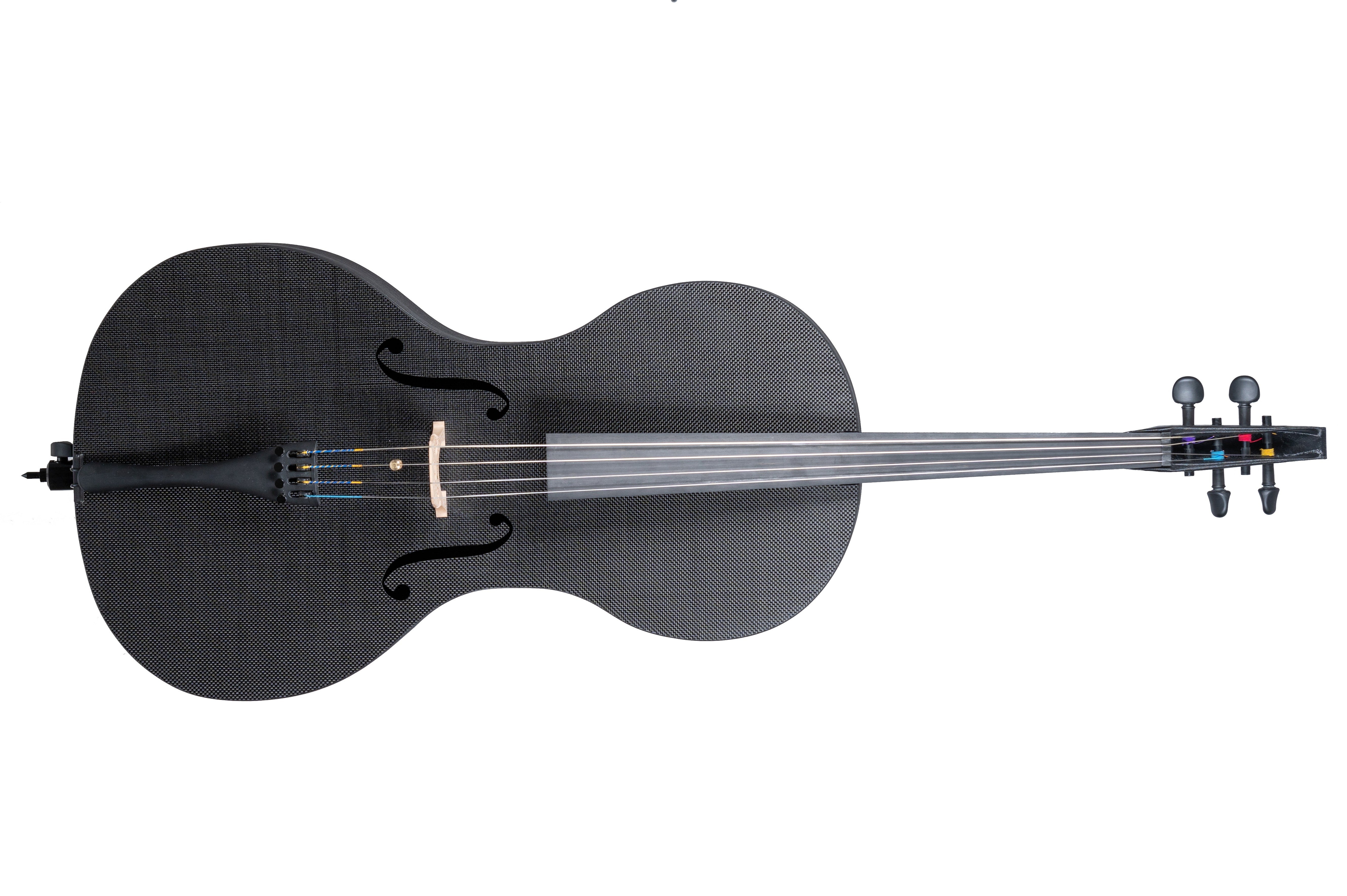
Their flagship product is the Forte3D Cello. Traditional cellos rely on carved, arched wooden tops to project sound. Forte3D ripped up the blueprints. They use flat, flexible carbon fiber sheets for the top and back of the instrument. Under the extreme tension of the cello strings, this flat top bows inward slightly, acting like a high-powered speaker cone.
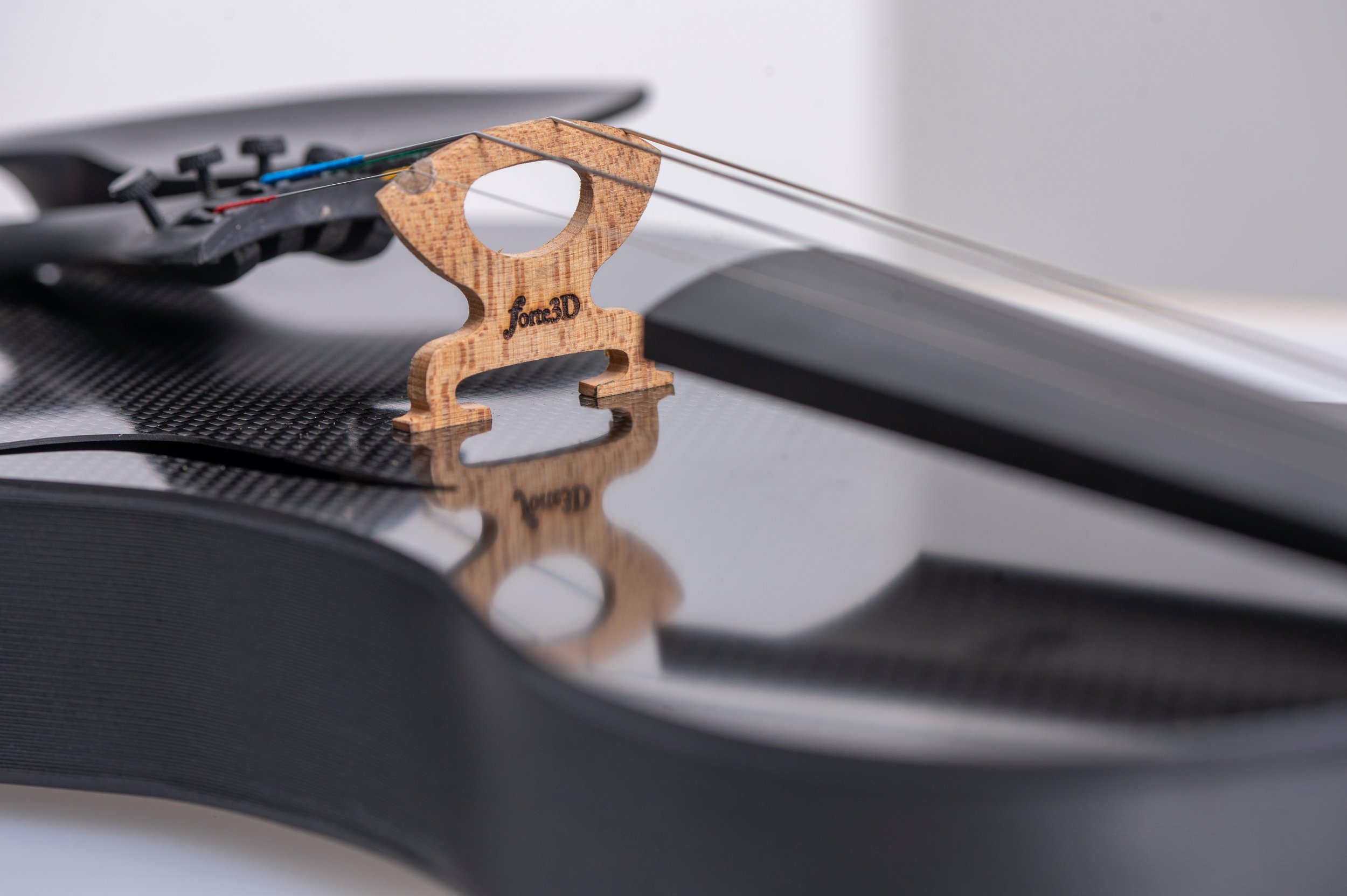
The ribs (the curved sides of the cello) and the neck are entirely 3D-printed using a proprietary carbon-fiber-infused polymer. However, the team was smart enough to know that some traditions exist for a reason. To preserve the authentic, warm tone of a classical string instrument, the bridge, soundpost, fingerboard, and tuning pegs are still made from high-quality wood.
The instruments feature a built-in mechanical innovation: a small, discreet screw mechanism that allows players to instantly adjust the neck projection and string height. Normally, adjusting a cello's action requires an expensive trip to a professional luthier. With Forte3D, a musician can tweak their setup in seconds using a simple tool. Furthermore, because the flat carbon fiber surfaces are essentially blank canvases, the company utilizes UV printing technology to allow customers to fully customize their instruments with full-color graphics, photos, or custom art.
| Product Overview | Key Details |
|---|---|
| Industry | Musical Instruments & Additive Manufacturing |
| Founded Year | 2022 |
| Core Product | 3D-Printed Carbon Fiber Cellos & Violins |
| Target Audience | Touring professionals, music students, educators |
| Retail Price | $3,000 (Cello), $1,800 (Violin) |
Who is the Founder of Forte3D?
Forte3D is the brainchild of a unique three-man partnership, bridging the gap between old-school craftsmanship, modern engineering, and elite musical performance.
Alfred Goodrich is the Founder and CEO. During the global pandemic, live performances halted, and Goodrich found himself tinkering in his Pennsylvania garage. Frustrated by the high cost and extreme fragility of wooden cellos, he wanted to build an alternative. He began experimenting with flat carbon fiber plates and 3D-printed parts. To his shock, his early garage prototypes actually sounded warm, rich, and highly resonant.
Realizing he needed technical expertise to scale the idea, Goodrich partnered with Elijah Lee, a brilliant biomedical engineering student at Yale University. Lee brought his deep knowledge of additive manufacturing and Computer-Aided Design (CAD) to the table. Lee was able to translate Goodrich’s rough garage experiments into precise, highly engineered digital models that could be flawlessly repeated by custom-built 3D printers.

The final piece of the puzzle was Mike Block, a Juilliard-trained, Grammy Award-winning cellist known for his work with Yo-Yo Ma’s Silk Road Ensemble. Block spent his career traveling the globe, constantly terrified that baggage handlers or extreme weather would destroy his priceless wooden cellos.
When Block played a Forte3D prototype, he was blown away. He immediately adopted the carbon fiber cello for his live tours and officially joined the company as a partner and Chief Musical Advisor.
Forte3D Shark Tank Journey & Pitch
The trio appeared on Shark Tank Season 17, Episode 6, stepping onto the carpet with a bold claim: they had built the world's first 3D-printed professional string instrument. They entered seeking $250,000 in exchange for 10% equity, placing a cool $2.5 million valuation on their startup.
The pitch opened with a heavy dose of showmanship. Mike Block performed a breathtaking solo on the Forte3D cello, filling the studio with a rich, booming, concert-hall sound. The Sharks were visibly stunned that the music was coming from a mixture of carbon fiber and 3D-printed plastic. Guest Shark Daniel Lubetzky even remarked that it was one of the greatest pitches he had ever seen on the show.
With the Sharks hooked on the sound, Alfred Goodrich laid out the business math. A quality wooden cello can run anywhere from $20,000 to over $100,000. Forte3D’s cello retails for just $3,000. More importantly for the investors, the landed cost to manufacture the instrument was only $800, leaving incredibly healthy margins. The company was also prepping to launch a violin that would retail for $1,800 with a manufacturing cost of just $450.
Financially, the company was scaling rapidly with no marketing spend. They reported $30,000 in sales in 2022, $150,000 in 2023, and $350,000 in 2024. They were projected to close 2025 at $500,000 in revenue, netting around $65,000 in pure profit.
Kevin O'Leary pushed back, questioning the total addressable market for cellos, but Goodrich quickly countered that the overall string instrument market is a $7 billion global industry. Despite the brilliant margins and flawless pitch, the Sharks began to show their teeth:
Daymond John was the first to drop out. He admitted the product was incredible but confessed he simply had zero connections or knowledge in the classical music space. Barbara Corcoran followed suit. While she loved the hustle, she didn't see a clear, rapid path to getting her investment back in a niche hardware market. Guest Shark Daniel Lubetzky, despite praising the presentation, opted out due to the valuation and the presence of other interested Sharks.
That left Kevin O’Leary and Lori Greiner. Mr. Wonderful loved the margins and offered $250,000 for 10% equity, but he attached his infamous royalty structure: he wanted $100 per unit sold until he recouped his $250,000.
Lori Greiner saw a massive, scalable business. She offered a clean equity deal: $250,000 for 18%, arguing that her vast retail and manufacturing empire could drastically reduce their $800 production costs. Goodrich, acting as the ultimate dealmaker, countered Lori at 15%. Lori held firm for a moment, and they ultimately met in the middle. The Forte3D team walked out of the Tank with a massive win.
| Pitch Element | Details |
|---|---|
| Initial Ask & Valuation | $250,000 for 10% ($2.5M Valuation) |
| Sharks in the Room | Daymond John, Barbara Corcoran, Kevin O'Leary, Lori Greiner, Daniel Lubetzky |
| Kevin O'Leary's Offer | $250,000 for 10% + $100 royalty per unit until $250k is repaid |
| Lori Greiner's Offer | $250,000 for 18% equity |
| Final Deal Accepted | $250,000 for 16% equity (Lori Greiner) |
What Happened to Forte3D After Shark Tank?
The "Shark Tank Effect" hit Forte3D like a tidal wave. Immediately following the airing of Season 17, Episode 6, the company experienced a massive surge in website traffic and orders. The exposure instantly validated their concept in the notoriously stubborn classical music community.
Using Lori Greiner's capital and logistical expertise, Forte3D officially launched their highly anticipated 3D-printed violin line. To capitalize on the TV momentum, they offered a limited-time 25% "Shark Tank exclusive" discount on the new violins, which led to a massive influx of pre-orders.
The biggest post-show victory, however, was the industry co-signs. The holy grail of the cello world, Yo-Yo Ma, publicly praised the innovation, stating that the music world desperately needed creative solutions to expand access to high-quality instruments. The wildly popular instrumental group The Piano Guys also tested and validated the instruments. For a company fighting against 400 years of wooden tradition, having the greatest cellists on earth bless their carbon fiber creations was the ultimate marketing tool.
Is Forte3D Still in Business?
Yes, Forte3D is fully operational, rapidly expanding, and highly profitable. The business has moved far beyond a garage startup and is now an established player in the modern luthier space.
They have heavily expanded their customization business. Because the flat carbon fiber tops act as a perfect printing canvas, Forte3D partnered with prominent designers like Juleez Art to create limited-edition, visually stunning cellos featuring vibrant, UV-printed cubist and abstract artwork.
In a massive milestone for co-founder Elijah Lee, Forte3D entered into an official co-design partnership with Yale University. Together, they are researching and developing the next generation of hybrid carbon fiber instruments, utilizing Yale's elite engineering facilities.
The company has also confirmed that fractional sizes (for children and young students), as well as 3D-printed violas and upright double basses, are in active development and slated for release in the near future.
What is the Valuation & Net Worth of Forte3D?
When the founders walked into the Tank, they valued their company at $2.5 million. By accepting Lori Greiner’s offer of $250,000 for 16% equity, the company’s implied post-money valuation shifted to $1.56 million.
However, that valuation was based on a snapshot of the business prior to the show's airing. In 2026, Forte3D is operating at a much higher capacity. They successfully hit their projected $500,000 revenue target for 2025 and have expanded their product catalog with the new violin line.
With lifetime sales quickly approaching the $1 million mark, and healthy profit margins intact, the company’s current valuation is realistically estimated to be hovering between $2.5 million and $3.5 million.
The estimated net worth of the founders, Alfred Goodrich, Elijah Lee, and Mike Block, is closely tied to their equity in the business. Combined, the founders' net worth is estimated to be around $1.5 million to $2 million, heavily weighted by the intellectual property, patents, and manufacturing assets owned by Forte3D.
Where to Buy Forte3D Instruments?
Currently, the only place to purchase a brand-new, authentic Forte3D instrument is directly through their official e-commerce website. Because each instrument is meticulously hand-assembled by Alfred Goodrich and his team in Pennsylvania, they operate on a build-to-order model.
Standard cellos and violins usually ship within two weeks of placing an order. If a customer opts for custom UV printing or specialized art tops, the production time is extended by an additional two weeks.
They currently offer domestic shipping across the United States, as well as calculated international shipping. Instruments are shipped in specialized, heavily padded boxes, with the neck and body sometimes shipped separately to save buyers hundreds of dollars on freight costs.
Are Forte3D Reviews Actually Good?
The reviews from verified buyers and professional musicians are overwhelmingly positive. In the string instrument community, synthetic materials are often viewed with deep skepticism. However, Forte3D has managed to win over the purists.
The primary praise centers around the projection and warmth of the sound. Unlike cheap fiberglass student cellos that sound thin and "tinny," the flat carbon fiber plates on the Forte3D vibrate with immense low-end power, mimicking the depth of aged wood.
Musicians also heavily praise the incredible durability. Reviewers frequently post videos taking their cellos outside in freezing temperatures, high humidity, and rain, environments that would instantly crack a $20,000 wooden instrument. The fact that a musician can gate-check a Forte3D cello under an airplane without buying a separate seat for the instrument has made it a favorite among touring bands.
Forte3D Alternatives: How Do They Compare?
While Forte3D is creating waves, they aren't the only company attempting to modernize classical strings.
- Mezzo Forte: This is Forte3D’s closest direct competitor. Mezzo Forte builds high-end carbon fiber violins and cellos. While their instruments are beautiful, they do not utilize 3D-printed ribs and are significantly more expensive. A Mezzo Forte cello can easily cost double the price of a Forte3D.
- Yamaha Silent Strings: For musicians who just want to practice without waking the neighbors, Yamaha’s electric "Silent" cellos and violins are the industry standard. However, these are strictly electric instruments that require an amplifier to be heard; they do not project acoustic sound like a Forte3D.
- Traditional Student Wood Cellos (Cecilio, Eastman): For beginners, factory-made wooden cellos from brands like Eastman or Cecilio remain the standard alternatives. While you can buy a beginner wooden cello for $500 to $1,000, they are incredibly fragile, prone to warping with weather changes, and require constant, expensive maintenance from a luthier, issues that Forte3D entirely eliminates.