
Getting phone calls from stranded drivers is the lifeline of any towing business. If your tow trucks are parked and your phone is silent, it is a frustrating experience. Luckily, there is Local SEO, a highly effective way to get your business in front of drivers exactly when they need help. Searching for a tow truck is almost always an emergency. Drivers will not scroll to the second page of Google. They click the first reliable company they see in the Map Pack. If you plan to get more calls, you need to make sure your towing company is the one showing up at the top.
💡 The Marketing Trifecta
While SEO delivers long-term traffic, it should always be paired with a strong paid and social foundation. Don't forget to implement our Complete Towing Company PPC Strategy for instant local leads, and utilize our Towing Social Media Marketing Guide to build community trust before a driver even calls you!
📊 The Current Local Search Landscape for Towing Companies
The way people search for emergency roadside help has shifted. Today, modern search engines focus heavily on proximity and "near me" intent. When a driver has a flat tire, they simply pull out their phone and search "tow truck near me." Google uses their exact GPS location to display the closest, most trusted options.
Furthermore, AI overviews are changing how results are displayed. Search engines are now providing direct answers to users before they even click a link. This means your towing company must have perfectly structured data and clear service areas to compete. If your business profile is not highly optimized, AI search bots will simply ignore your company and recommend a competitor. Understanding this immediate search behavior is the key to winning the local market.
The Core Framework: Winning Local SEO in the Towing Industry
If you want an SEO framework that truly drives emergency calls, you must focus on the Local Map Pack. For service area businesses like towing, your primary goal is to dominate the top three spots on Google Maps. This is not about getting traffic from across the country; it is about dominating the 15-mile radius around your dispatch center.
The core framework relies on three main pillars: a verified Service Area Google Business Profile, a massive volume of highly-rated customer reviews, and hyper-local city landing pages. You cannot rely on a single "Services" page to pull in traffic from 10 different surrounding towns. You must build a dedicated strategy for each specific location you serve. When these three pillars are combined, they create a safety net of local relevance that keeps your trucks moving 24/7.
The 10-Step Local SEO Blueprint for Towing Companies
Step 1: GBP Optimization & Service Area Definitions
A major issue for towing companies is Google Business Profile suspensions. Many towing businesses use fake addresses or P.O. boxes to try and rank in cities where they do not actually have an office. This violates Google's strict guidelines. Since towing is a Service Area Business (SAB) that goes to the customer, you must hide your physical address if it is just your home.
Instead, use the dashboard to set your exact service areas by adding specific zip codes, counties, and cities. Select "Towing Service" as your primary category. If your profile gets suspended due to an address error, your inbound calls will drop to zero overnight. Properly defining your service area keeps your business compliant and visible to the right drivers in emergencies.
Step 2: Google Local Services Ads (LSA) Integration
Organic SEO takes time to mature. While you build your local rankings, you are leaving money on the table if you are not at the very top of the page. Stranded drivers click the first trusted link they see.
You should implement Google Local Services Ads and earn the Google Guaranteed badge. You will need to pass a background check and provide proof of insurance. Once approved, you get a green checkmark next to your name. The best part is that you only pay for actual phone calls, not just clicks. This creates an immediate lead generation source that works in perfect harmony with your long-term organic SEO efforts.
Step 3: NAP Consistency & Aggressive Citation Cleanup
If your business name is "A1 Towing" on Yelp, but "A1 Towing & Recovery" on your website, Google gets confused. Inconsistent Name, Address, and Phone number (NAP) data across the internet destroys search engine trust. If Google does not trust your data, it will not rank you in the Map Pack.
You must perform a deep audit of your local citations. Check YellowPages, BBB, Angi, and local Chamber of Commerce directories. Make sure your business details match your Google profile exactly. Cleaning up this messy data sends a massive trust signal to Google, proving your towing business is legitimate, established, and highly reliable.
Step 4: Hyper-Local Emergency Landing Pages
Many towing websites have a single page listing all the cities they serve. When a driver searches for a "tow truck in [Neighboring Town]," your generic homepage will not rank. Search engines want to serve highly localized results.
The fix is to build dedicated, hyper-local landing pages for each city in your service radius. Create a specific page for "Tow Truck Service in [City A]" and another for "[City B]." Ensure the text on these pages is unique. Embed local Google Maps and highlight local landmarks. This expands your digital footprint and captures high-intent traffic from surrounding suburbs.
Step 5: Automated Review Generation
People will not trust a towing company with a 3-star rating or no recent reviews. Because the industry has a bad reputation for predatory pricing, positive reviews are your strongest currency. If your closest competitor has 150 reviews and you have 10, they will get the call every time.
You must set up an automated review generation system. Right after your driver drops a car off and the customer is safely home, send them an automated text message thanking them for their business and providing a direct link to your Google review page. Reply to all reviews using keywords like, "Happy we could provide fast flatbed towing for you!" High review velocity is a primary ranking factor for the Map Pack.
Step 6: Geo-Tagged Truck and Job Site Photos
Using generic stock photos of tow trucks tells Google absolutely nothing about your local presence. Search engines look for geographic proof that you actually operate in the cities you claim to serve.
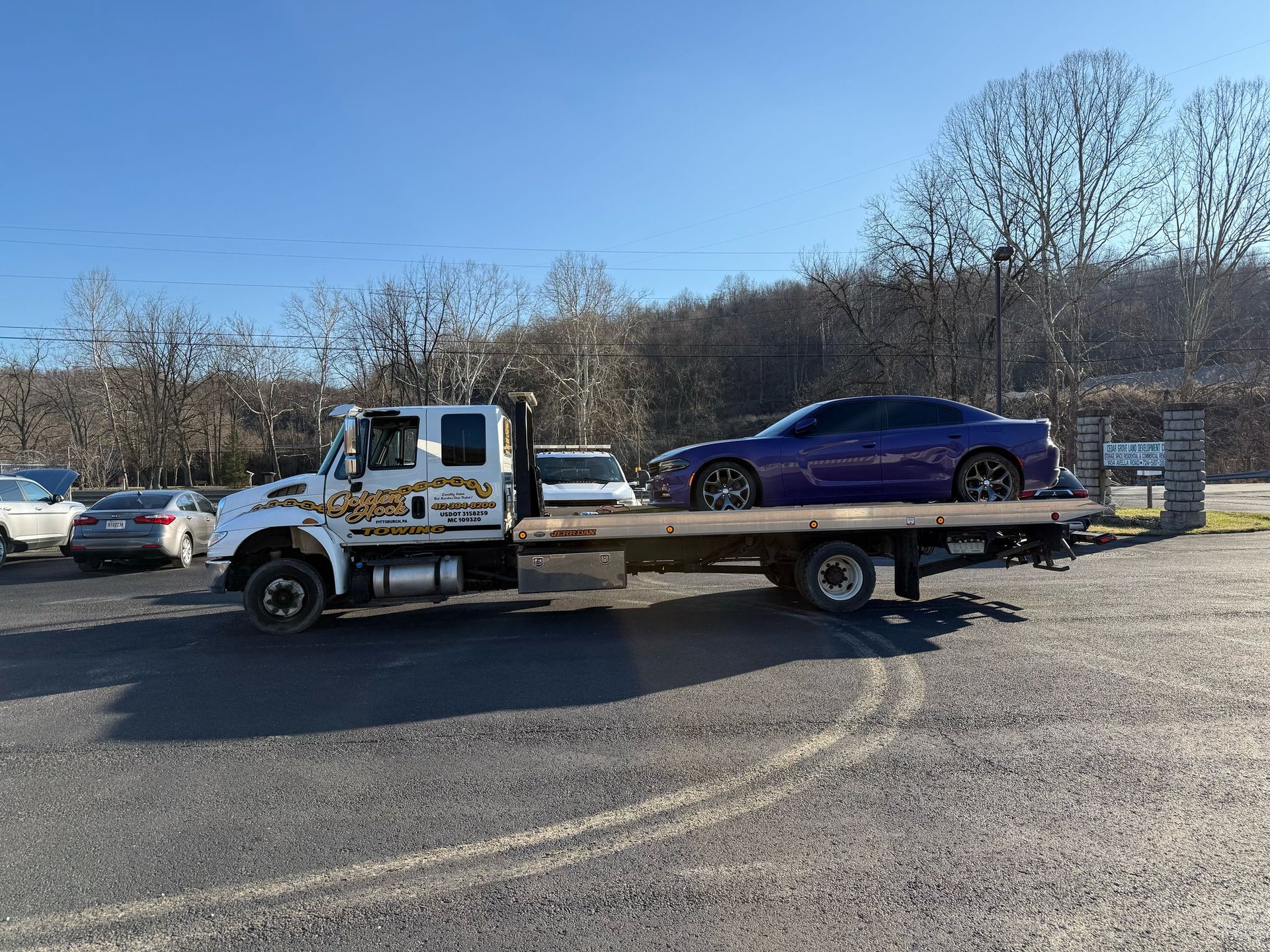
Have your drivers take photos of their trucks while out on jobs using their smartphones with location services turned on. These photos contain hidden GPS data (EXIF data). When you upload these geo-tagged photos to your Google Business Profile and local landing pages, it feeds Google undeniable proof of your service area. This pushes your map rankings higher across a wider radius.
Step 7: High-Authority Local Link Building
Without inbound links from other websites, your towing site lacks the authority needed to outrank older competitors. Search engines view backlinks as digital votes of confidence.
You need to actively pursue local link building. Join the local Chamber of Commerce, sponsor a high school sports team, or partner with local auto repair shops who can link back to you as their preferred towing provider. These local, highly relevant backlinks pass massive authority to your website, signaling to Google that you are an established community staple.
Step 8: Advanced Schema Markup (JSON-LD)
Search engine bots prefer to read structured data rather than guessing the context of your paragraphs. Without schema markup, you force the algorithm to work harder to understand your 24/7 operating hours and emergency contact details.
Inject "LocalBusiness" and "Service" schema directly into the backend code of your website. Clearly define your 24-hour emergency status, your precise geo-coordinates, and your accepted payment methods. This technical optimization allows Google to confidently display your business in rich snippets, making your listing stand out visually and increasing your click-through rates.
Step 9: Optimizing for Apple Maps and Bing Places
Ignoring non-Google platforms means you are throwing away a massive segment of mobile users. When someone's car breaks down, they often use voice commands like "Hey Siri, find a tow truck." Siri pulls data directly from Apple Maps, not Google.
You must claim and fully optimize your business profiles on Apple Business Connect and Bing Places for Business. Ensure your NAP data is perfectly consistent with your Google listing. Capturing this alternative mobile traffic requires very little initial setup but provides an ongoing stream of highly lucrative emergency calls that your competitors are completely missing.
Step 10: Geo-Grid Tracking & Performance Reporting
Searching for your own business from the dispatch office gives you a biased, fake ranking report. You will always appear number one when you are sitting at your own desk. If you do not know where your visibility drops off across the highway system, you cannot fix it.
Use geo-grid tracking software to drop a digital map over your entire service area. This tool checks your Map Pack ranking from dozens of specific GPS coordinates. If you rank #1 in the north but #7 in the south, you know exactly where to deploy targeted content, run local ads, and gather specific neighborhood reviews to expand your dominance radius.
The Essential 5-Tool Local SEO Stack 🛠️
If you want to execute this 10-step blueprint effectively, you need the right software. Here are exactly 5 tools that are absolutely essential right now for towing local search execution.
1. BrightLocal
An all-in-one local SEO platform built for businesses to manage their complete search presence and audit their local citations.
Comprehensive local search audit tool, citation builder, and robust review management dashboard.
Very affordable and the audit reports are highly visual and easy to understand.
The sheer volume of data can be overwhelming for total beginners.
2. Local Falcon
The industry standard for Google Maps grid tracking. It visualizes exactly how your GBP ranks across a multi-mile grid around your dispatch center.
Geo-grid reporting, competitor proximity tracking, and historical trend analysis.
The visual heat map is undeniable proof of where your local SEO is failing or succeeding. Perfect for SABs.
Operates on a credit system, which can get expensive if you run daily scans.
3. Ahrefs
For deep keyword research and link building analysis, Ahrefs is a powerhouse. You can look up exact monthly search volumes for emergency queries.
Site Explorer, Keyword Explorer, Site Audit tool.
The largest and fastest backlink database available; highly accurate keyword difficulty scores.
It is quite pricey for a single small business owner, starting at $99 per month.
4. Towbook
A robust dispatching and management software that is a massive asset for towing operators to manage dispatch and marketing automatically.
Along with scheduling, it includes automated customer communication tools to request reviews via SMS.
It deeply integrates review generation into your daily workflow without extra effort from your drivers.
It requires setting up your entire dispatching system on their specific platform.
5. SEOptimer
If you need a quick technical health check on your website, this tool evaluates your on-page SEO rapidly. It checks your title tags, meta descriptions, and mobile page speed.
Website Audit, White-label reporting, Keyword tracking.
Very fast and provides a simple, actionable checklist of errors to fix on your site.
Lacks the deep off-page citation and backlink analysis found in larger enterprise tools.

Case Study 1: How Rapid Towing Dominated the Map Pack
Rapid Towing, a local roadside assistance company, had a major issue. Despite having top-of-the-line wreckers and an expert crew, they were invisible for "tow truck near me" searches outside of their immediate 2-mile radius. They were bleeding cash on generic Pay-Per-Click ads just to keep their drivers busy.
Action The Execution:
They deployed a strict 10-step SEO blueprint. First, they fixed their GBP Service Area settings to comply with Google’s SAB guidelines. Then, they built 12 highly optimized, city-specific landing pages for surrounding suburbs. They aggressively launched an automated SMS review campaign and started uploading geo-tagged job photos directly from the field. Finally, they cleaned up massive NAP inconsistencies across 60+ local directories.
📈 The Results:
Within 4 months, Rapid Towing secured top 3 Map Pack rankings across 8 of their 12 target cities. Their inbound organic emergency calls increased by 315%. Because they were capturing free organic traffic with high intent, their cost per acquisition plummeted, driving an additional $85,000 in monthly revenue while slashing their ad spend by half.
Case Study 2: How All-State Recovery Scaled Multi-Location SEO
All-State Recovery operated across three different major counties. Their problem was duplicate content and keyword cannibalization. They had one website trying to serve three distinct regions with identical text, confusing Google's algorithm. Because of this poor structure, they were losing high-value commercial towing jobs to smaller, hyper-local competitors in each region.
Action The Execution:
They initiated a massive website architecture overhaul. They built three distinct "Location Hubs" on their site, treating each county as its own isolated local SEO environment. They wrote completely unique, 1,500-word service pages for each hub, injected specific LocalBusiness schema, and built separate, verified Google Business Profiles for each hub's dispatch center. They then pursued highly specific local backlinks for each separate county.
📈 The Results:
The multi-location silo strategy worked perfectly. All-State Recovery achieved page-one dominance across all three counties simultaneously without any algorithm penalties. Their overall organic traffic grew by 180% year-over-year, allowing them to confidently open two new dispatch locations funded entirely by the massive influx of organic, high-margin commercial towing leads.
Future-Proofing Your Local Visibility
Search engine algorithms change often, but the core of local SEO remains the same. To survive future updates, you must maintain a strong focus on real-world trust and E-E-A-T signals. Never rely on black-hat tactics or fake virtual offices, as Google's spam detection AI is becoming incredibly precise.
Keep updating your Google Business Profile with fresh photos of your trucks, equipment, and drivers. Never stop gathering authentic customer reviews. Ensure your website continues to provide fast, mobile-friendly, and highly accurate service area information. By focusing on giving stranded drivers the best, fastest online experience possible, your local rankings will remain stable and highly profitable for years to come.