Table of Contents
Let's face it: the traditional dinner-and-a-movie date night has gotten a little stale. Even the once-popular "paint and sip" classes have lost some of their magic. People want to get their hands dirty, build something real, and maybe enjoy a craft cocktail while doing it. Enter Makers Social, a business that asks a simple but daring question: what happens if you mix power tools, leatherworking, and alcohol?
When founder Megan Pando walked onto the Shark Tank stage in Season 17, she brought a bold new concept in experiential entertainment. She wasn't pitching a gadget or a packaged snack. She was pitching an experience.
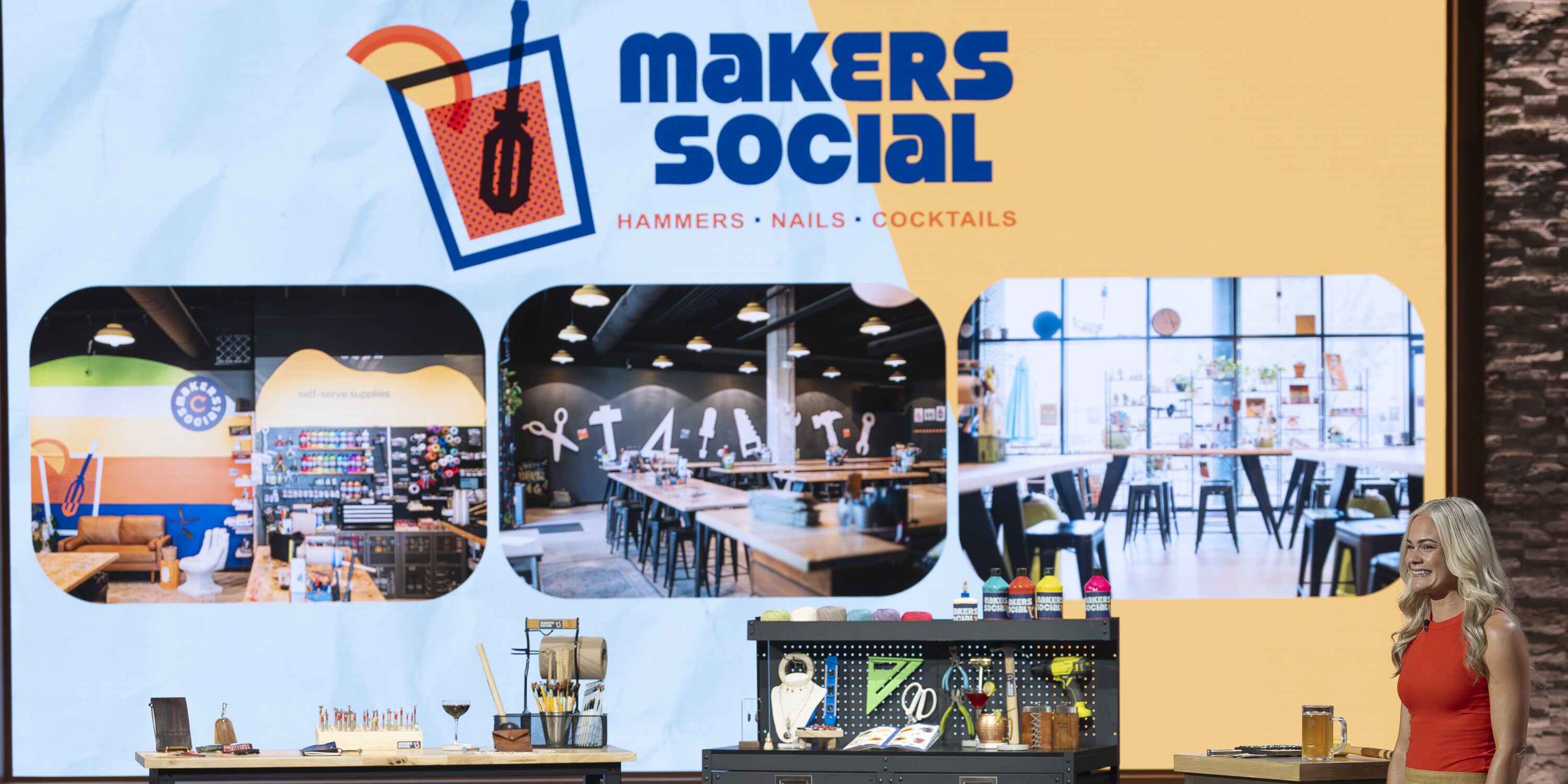
Makers Social is a Columbus, Ohio-based DIY project bar where adults can gather, drink, and craft everything from custom jewelry to wooden drink flights. The pitch had the Sharks buzzing with questions about liability, scalability, and profit margins. But did she walk away with a deal, and more importantly, what happened after the cameras stopped rolling? Here is the complete, up-to-date look at Makers Social.
Who is the Founder of Makers Social?
Megan Pando is the creative powerhouse behind Makers Social. She graduated from the University of Cincinnati in 2013 with a Bachelor's Degree in Studio Arts. Spending hours in shared college studios, she loved the feeling of working side-by-side with other creatives. She realized that once adults leave school, they rarely have access to tools, workshop space, or a community of fellow makers.
Before Makers Social, Megan tested the waters of experiential entertainment. She launched Studio 614, a highly successful paint-and-sip business in Columbus. That venture taught her exactly what customers want out of a social night, how to run large group events, and how to guide absolute beginners through a creative process.
After building Studio 614 into a profitable local staple, she sold it. She took $300,000 of her own savings from that sale and poured it into her true passion project: Makers Social.
The timing, however, could not have been worse. She opened the doors to Makers Social in early 2020, just one month before the global pandemic shut down the entire hospitality industry. Opening an in-person, interactive business during a time of extreme social distancing was a nightmare. But Megan refused to let her dream die. She adapted, survived the shutdowns, and eventually built Makers Social into a thriving local hotspot once restrictions lifted.
Makers Social Shark Tank Journey & Pitch
Megan Pando stepped into the Tank during Season 17, Episode 9, which aired in January 2026. She came in looking for $150,000 in exchange for a 10% equity stake in her business. This initial ask gave Makers Social an implied valuation of $1.5 million.
She set the stage beautifully, walking the Sharks through the concept of a DIY project bar. To demonstrate the experience, she had the Sharks try their hands at a custom leather wallet project right there in the Tank. They grabbed hammers and metal stamps to imprint their initials into the leather. The Sharks were immediately engaged and clearly enjoyed the hands-on aspect of the pitch.
Then, it was time to talk numbers. Megan revealed that in 2023, the business generated an impressive $504,000. In 2024, sales grew to $546,000. The Sharks were blown away by her project margins, which sat at a massive 95%. Her Customer Acquisition Cost (CAC) was practically nonexistent at just $0.82 per customer, largely because word-of-mouth and social media drove most of her foot traffic. The average customer spent $62 per visit.
However, the mood shifted when they dug into the bottom line. Megan admitted that after paying her 24% labor costs and taking a salary for herself, the business only netted $41,000 in pure profit.
| Shark Tank Details | Figures & Outcomes |
|---|---|
| Season & Episode | Season 17, Episode 9 (2026) |
| Founder | Megan Pando |
| Initial Ask | $150,000 for 10% Equity |
| Pre-Pitch Valuation | $1.5 Million |
| Sharks in the Room | Kevin O'Leary, Lori Greiner, Robert Herjavec, Kendra Scott, Rashaun Williams |
| Offers Made | Kevin O'Leary: $150,000 for 20% + $0.20 royalty per distribution dollar |
| Final Deal | Kevin O'Leary ($150,000 for 20%) |
This sparked a heated debate among the investors. Robert Herjavec and Lori Greiner praised the concept but voiced major concerns about scalability. They believed the business was far too reliant on Megan's unique personality and relentless work ethic. They worried that if she tried to franchise or open new locations, the magic of the original spot would get lost. Because they could not see a clear path to national expansion without Megan being in two places at once, both Robert and Lori dropped out.
Kevin O'Leary, however, saw something different. Mr. Wonderful loves businesses that generate real cash and have proven demand. He noted that the concept reminded him of previous Shark Tank successes in the paint-and-sip space, but elevated for a new decade.
True to form, Kevin made an offer designed to protect his downside while securing a larger piece of the pie. He offered Megan the $150,000 she asked for, but demanded 20% equity instead of 10%. On top of that, he added a stipulation: he wanted a 20-cent royalty on every dollar distributed as profit until he recouped his original $150,000 investment.
Megan hesitated. Giving up twice as much equity as she planned was a tough pill to swallow. But recognizing the value of having a Shark with Kevin's financial connections to help her fund a second location, she accepted the deal.
What Happened to Makers Social After Shark Tank?
The "Shark Tank Effect" is very real, and Makers Social experienced it instantly. The moment the episode aired on ABC and began streaming on Hulu, the company's website was hit with a massive wave of traffic.
Because the business is a physical location in Ohio, the nationwide television exposure did not translate to millions of immediate product sales like it does for e-commerce brands. However, the exposure did wonders for their local booking system. Their reservation calendar filled up weeks in advance. Corporate event planners from across the Midwest began reaching out to book private parties and team-building retreats.
Megan also reported that her inbox was flooded with franchise inquiries from people in other states who wanted to open a Makers Social in their own cities. Behind the scenes, the deal with Kevin O'Leary moved into the due diligence phase. This is the standard legal and financial review process that happens after a handshake on television. The funds from Kevin are earmarked specifically to help Megan sign a lease and build out a second Makers Social location, proving to the other Sharks that the model can indeed be scaled.
Is Makers Social Still in Business?
Yes, Makers Social is absolutely still in business and doing great. In fact, the company is doing better than ever. The flagship location in the Franklinton Arts District of Columbus remains a highly popular destination for locals and tourists alike.
They continue to update their project menu to keep repeat customers coming back. Seasonal projects, like holiday ornaments or summer patio games, have been added to the rotation. They also run successful weekday promotions, including a "Happy Hour" that draws in the post-work crowd, and weekend family days where kids get 50% off select crafts.
Megan Pando is currently focused on optimizing operations at the first location so she can step back from day-to-day management. This is a direct response to the Sharks' feedback about founder dependency. By tightening up her training manuals and standard operating procedures, she is preparing the business for its upcoming expansion to a second location.
What is the Valuation & Net Worth of Makers Social?
When Megan Pando walked into the Tank, she valued Makers Social at $1.5 million based on her $150,000 ask for 10%. When she accepted Kevin O'Leary's offer of $150,000 for 20%, the mathematical valuation of the company dropped to $750,000. This is a common occurrence on the show, as Sharks often demand a higher equity stake to account for the risk of investing in a brick-and-mortar hospitality business.
The estimated net worth of Makers Social sits comfortably around the $1 million to $1.2 million mark. This estimate factors in the company's consistent annual revenue of over $540,000, their incredibly high 95% gross margin on craft projects, and the physical assets inside the Columbus location.
If the upcoming second location launches successfully and proves the model is repeatable, the valuation of the company will easily skyrocket past the $3 million mark within the next few years.
Where to Find Makers Social?
Right now, the only place to experience Makers Social in person is at their original location in Columbus, Ohio. If you live in the Midwest or are passing through for a weekend trip, you can easily book a table directly through their official website. They highly recommend making reservations in advance, especially for Friday and Saturday nights, as the Shark Tank exposure has made walk-in availability extremely limited.
For those who live out of state, the brand has hinted at potential expansion. While there are no official franchise locations open yet, Megan's long-term goal is to bring the Makers Social concept to major metropolitan areas across the United States.
Are Makers Social Reviews Good?
The customer feedback for Makers Social is overwhelmingly positive. A quick glance at online review platforms shows that visitors love the concept, frequently praising it as a refreshing alternative to standard bars or cramped restaurants.
Patrons frequently highlight the helpfulness of the staff. Many reviews note that even people who describe themselves as "completely uncreative" leave with a high-quality product they are proud to display in their homes. Customers also appreciate that the pricing is transparent; the cost of your project generally covers your materials and your seat for the evening, while drinks and snacks are billed separately.
The only occasional complaints stem from the sheer volume of noise in the venue on busy nights. Between the music, the chatter of a packed bar, and the sound of hammers hitting metal, it is an energetic and loud environment. It is definitely the place for a lively group outing rather than a quiet, intimate conversation.
Is it Safe to Combine Power Tools and Alcohol?
This was the number one question viewers had when the pitch aired, and it lit up internet message boards like Reddit. Mixing heavy machinery with a liquor license sounds like a recipe for disaster.
However, Makers Social has a very strict safety protocol that eliminates the risk. Customers do not operate dangerous power saws or heavy machinery. All the high-risk fabrication like cutting thick lumber to size or drilling complex holes is handled entirely by the sober, highly trained staff behind the scenes.
The tools given to customers at their tables are low-risk hand tools: hammers, sandpaper, leather stamps, paintbrushes, and simple hand drills. You are doing the fun, aesthetic work of assembling and personalizing the craft, not the dangerous construction. It is a highly controlled environment designed to maximize fun while keeping liability to an absolute minimum.